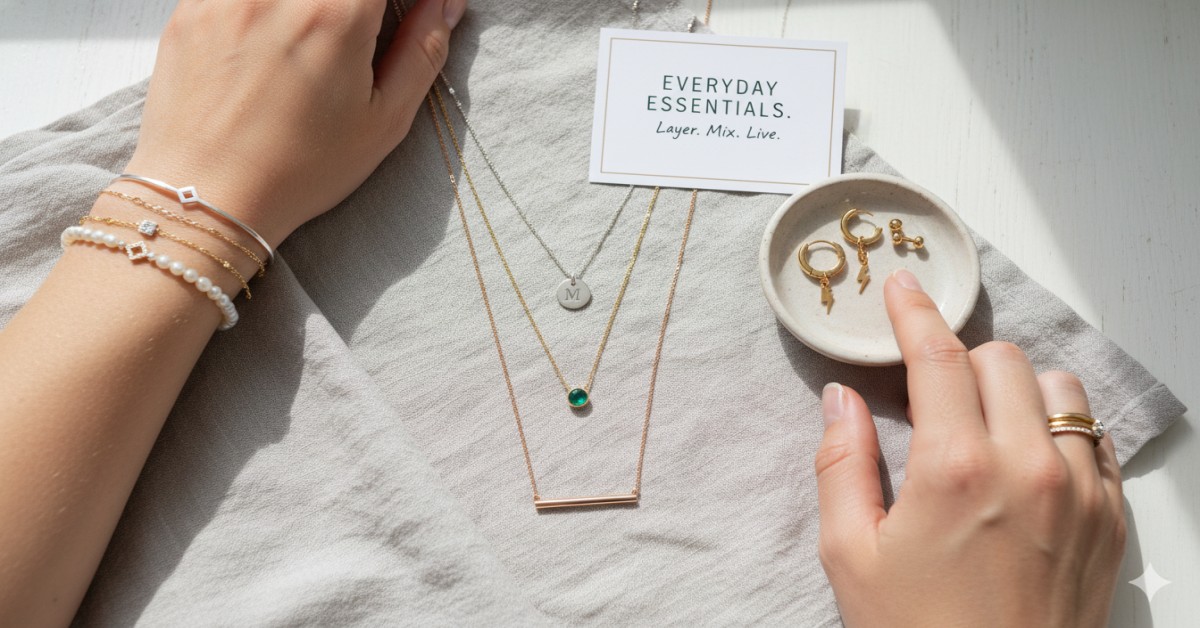
There was a time when wearing jewelry meant picking one piece. You wore the heavy necklace or the big earrings. You wore the gold bangles or the watch.
But fashion has evolved. In 2025, we don’t just wear jewelry; we curate it. We are in the era of the #NeckMess and the #WristStack. The goal isn’t to look perfectly matched. The goal is to look interesting. To look like you collected these pieces over years of travel and life experiences.
Layering and Mixing is the art of wearing multiple pieces at once without looking cluttered. It’s about mixing metals, mixing textures, and mixing old with new. It allows you to wear your grandmother’s gold chain with a trendy rose gold pendant.
But let’s be honest—it’s harder than it looks on Instagram. If you just throw everything on, you end up looking like a tangled mess. In this guide, I am going to teach you the Rules of Layering, the new essential pieces you need to buy, and how to mix metals like a pro.
Read more: The Future is Flexible
Part 1: The Neck Stack (The “Cascade” Effect)
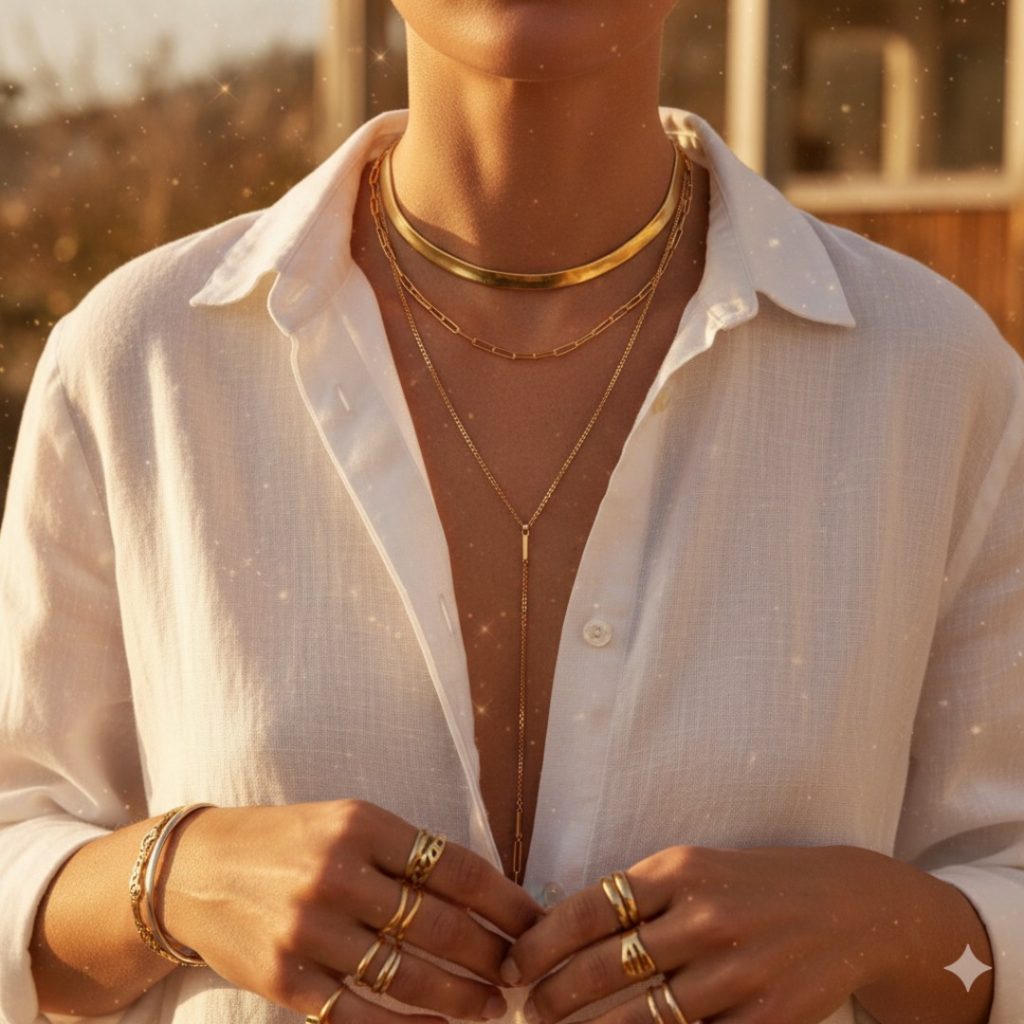
The secret to a perfect neck stack is Length Variation. If all your chains are 16 inches, they will bunch up and tangle. You need distinct “Zones.”
Zone 1: The Choker (14-15 inches)
- The Piece: This sits high on the neck, almost like a collar.
- New 2025 Trend:The “Snake” Chain.
- Why: It is flat, smooth, and liquid-like. It provides a solid foundation for the stack.
- Alternative: A delicate Pearl Choker or a beaded gemstone string. It adds texture against the metal chains below.
Zone 2: The Pendant (16-18 inches)
- The Piece: This is your focal point. It sits right below the collarbone.
- New 2025 Trend:The “Medallion” or Coin.
- Why: A round gold coin (like a Roman coin or Zodiac sign) anchors the look. It adds weight.
- Alternative: An Initial Pendant or a small Diamond Solitaire.
Zone 3: The Long Chain (20-24 inches)
- The Piece: This elongates the torso and plunges into the neckline.
- New 2025 Trend:The “Lariat” or Y-Necklace.
- Why: It breaks the pattern of circles (choker/pendant) by adding a vertical line. It looks incredibly chic with button-down shirts left open or V-neck tees.
The Golden Rule: Always mix Chain Types. Don’t wear three identical cable chains. Wear one Snake Chain (flat), one Paperclip Chain (open links), and one Rope Chain (twisted). The contrast in texture prevents them from tangling into a knot.
Part 2: The Wrist Stack (Arm Candy)
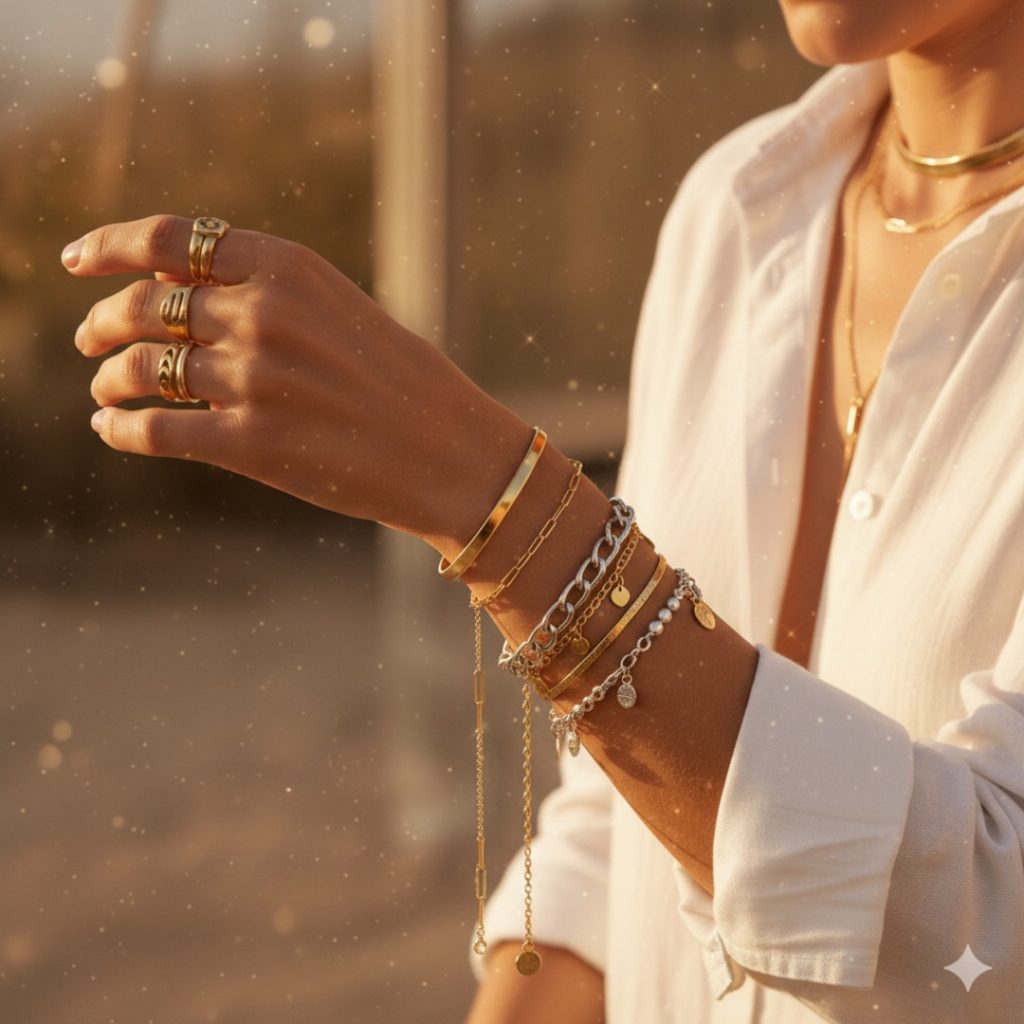
Your hands are the most visible part of you—you talk with them, type with them, drink coffee with them. The Wrist Stack is about mixing Rigid with Fluid.
1. The Anchor: The Watch
- Start with your watch. It is the heaviest item.
- If you have a silver/steel watch, this is the perfect base for a mixed-metal look.
2. The Rigid: The Bangle/Cuff
- New 2025 Trend:The Open Cuff.
- Look: A solid gold C-shaped bangle that doesn’t close fully. It sits next to the watch and holds its shape.
- Why: It provides structure.
3. The Fluid: The Chain Bracelet
- New 2025 Trend:The Paperclip Bracelet.
- Look: A flexible chain that drapes over your wrist bone.
- Why: It adds movement. It softens the look of the hard watch and cuff.
4. The Sparkle: The Tennis Bracelet
- New 2025 Trend:The “Bezel Set” Tennis Bracelet.
- Look: A thin line of diamonds (or zircon) where each stone is wrapped in gold.
- Why: It adds a flash of light. It makes the stack look expensive.
The Golden Rule: Keep it odd. Stacks of 3 or 5 items look better than even numbers. (e.g., Watch + Cuff + Chain = Perfect).
Part 3: The Ear Stack (The Curated Ear)

You don’t need multiple piercings to nail this trend (but it helps!). If you only have one hole, use Ear Cuffs.
The Anatomy of a Stack:
- Lobe 1 (Main Hole): The biggest earring. A Gold Huggie Hoop or a small geometric stud.
- Lobe 2/3 (Upper Lobe): Tiny studs. Think Gold Dots, Stars, or Tiny Diamonds.
- Helix (Cartilage): The Ear Cuff.
- New 2025 Trend: Chunky Gold Cuffs. Instead of thin wire cuffs, we are seeing thick, bold cuffs that look like you have a conch piercing.
The Golden Rule: Gradation. The jewelry should get smaller as it goes up the ear. Big at the bottom, tiny at the top.
Part 4: Mixing Metals (Breaking the Taboo)
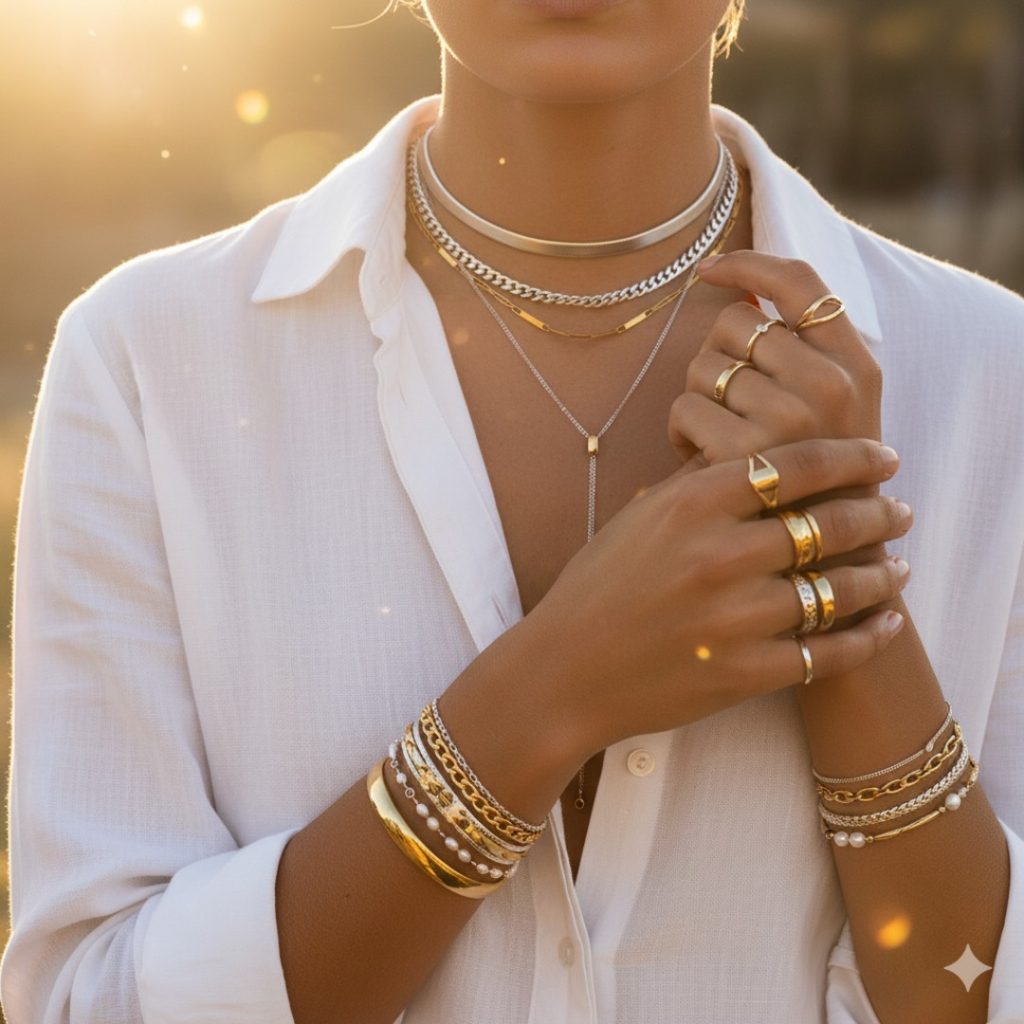
“You can’t mix Gold and Silver.” Lie. In 2025, mixing metals is the hallmark of a cool girl. It shows you aren’t trying too hard to be perfect.
How to do it safely:
- The Bridge Piece: Wear one piece of jewelry that contains both metals.
- Example: A ring with bands of both Yellow Gold and White Gold. This piece “gives permission” for the rest of your outfit to mix.
- The Ratio: Aim for a 70/30 split.
- Don’t do 50% Gold and 50% Silver. It looks like you couldn’t decide.
- Do mostly Gold with a pop of Silver (or vice versa).
- Texture Match: Ensure both metals have the same finish (e.g., both high-polish shiny, or both matte). Mixing shiny gold with oxidized black silver usually clashes.
Buying Guide: Essential “Layering” Pieces
If you want to start layering, you need these basic building blocks.
1. The “Connector” or “Extender”
- What is it? A small piece of gold chain (2 inches) with clasps on both ends.
- Why buy: It allows you to change the length of your necklaces. If you have two necklaces that are both 18 inches, use an extender on one to make it 20 inches so they layer perfectly.
2. The “Detangler” Clasp
- What is it? A single magnetic clasp that has hooks for 3 different necklaces.
- Why buy: You hook all three necklaces onto this one clasp. It keeps them separated on your neck so they never twist into a knot. It is a lifesaver for the layered look.
3. Lightweight 14k/18k Gold
- Why: Layering means wearing multiple pieces. If they are all heavy 22k gold, your neck will hurt.
- Buy: 14k or 18k Gold. It is lighter, durable, and cheaper, allowing you to buy 3 chains for the price of one heavy one.
Conclusion: Tell Your Story
The beauty of Layering and Mixing is that it is personal. No two stacks are the same. You might layer a shell necklace from your Goa trip with a diamond pendant from your engagement and a gold chain from your mom. That combination? That’s your life story on your neck.
So, don’t be afraid to experiment. Put on the silver watch with the gold bangle. Wear the pearls with the chains. Play with your jewelry. Because the only rule in 2025 is: If you like it, layer it.
I’d love to know: Are you a “Silver Girl,” a “Gold Girl,” or do you dare to mix them? Let me know in the comments below!
Frequently Asked Questions (FAQs)
How do I stop my layered necklaces from tangling?
Tangling happens when chains are the same weight and length.
Fix 1: Mix textures (e.g., Snake chain + Rope chain). Different textures don’t grip each other as much.
Fix 2: Use a “Necklace Detangler” (a multi-strand clasp).
Fix 3: Put them on 2 inches apart in length (e.g., 16″, 18″, 20″).
Can I layer gold with artificial jewelry?
High-low mixing is very trendy. You can mix a real 18k Gold Chain with a fun, colorful beaded necklace or a chunky brass chain. Just be careful that the artificial metal doesn’t rub against the real gold too much, as hard base metals can scratch soft gold.
Is rose gold good for mixing?
Rose Gold is the “Diplomat” of metals. It bridges the gap between Yellow Gold and Silver. If you want to mix Silver and Gold but feel it looks harsh, throw in a Rose Gold piece in the middle. It softens the transition and makes the mix look intentional.
How many rings are too many?
There is no hard limit, but you want to maintain function.
Rule: Keep at least one finger bare on each hand (usually the pinky or thumb) to avoid looking like you are wearing a knuckle-duster.
Balance: If you have a heavy stack on the Ring finger, wear a midi-ring on the Index finger to balance the visual weight.