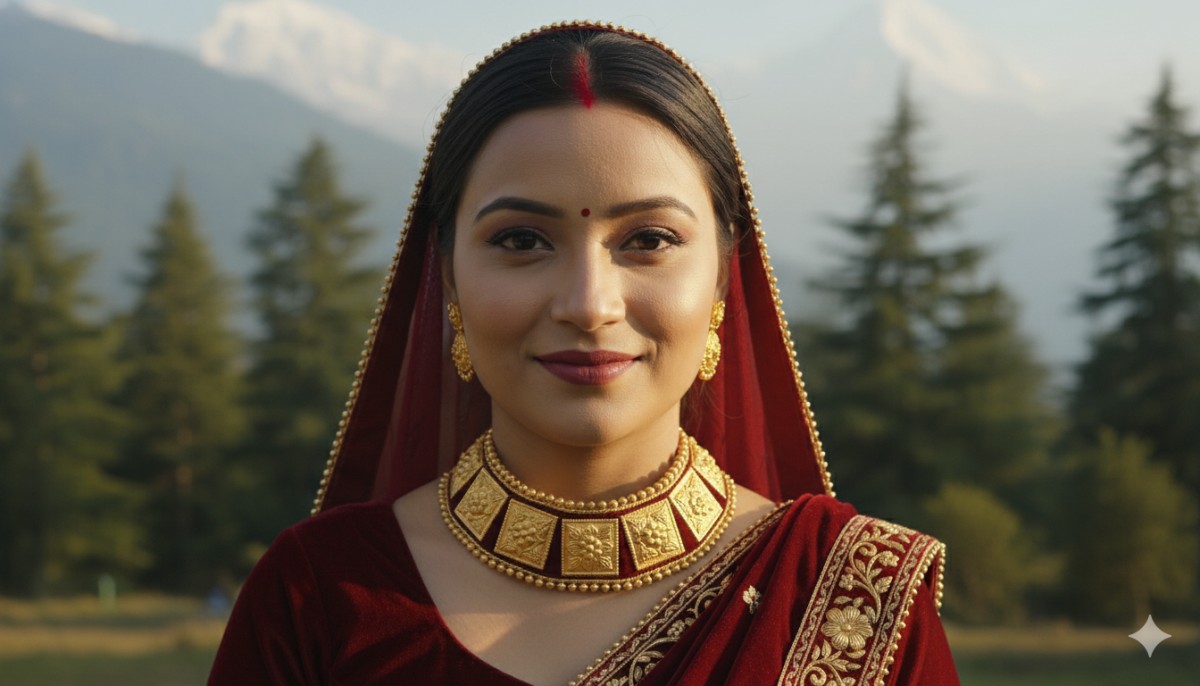
If you have ever attended a wedding in the misty hills of Himachal Pradesh, you have definitely noticed it. Amidst the heavy nath (nose ring) and the long silver chains, there is one piece of jewelry that steals the show every single time. It sits high on the neck, regal and distinct—gold squares resting on a bed of plush maroon velvet.
This is the Himachali Guluband.
For years, this masterpiece was a hidden gem of the Himalayas, worn strictly by Pahari women in regions like Kangra, Mandi, and Kullu. But today? The secret is out. I am seeing Himachali Guluband designs popping up in bridal trousseaus from Delhi to Mumbai.
Why the sudden fame? Because it offers something that modern machine-made jewelry lacks: Soul.
In this guide, I am going to take you through the magic of the Guluband. We will talk about why it’s the perfect blend of comfort and royalty, how much gold goes into it, and how you—yes, even if you aren’t Pahari—can rock this style with elegance.
Read more: 3D Name Necklaces in Gold
What Exactly is a Guluband?
Let’s break it down. The word comes from “Gulu” (Neck) and “Band” (Tie or Bond). Essentially, it is a choker.
But unlike the stiff, solid metal chokers we see in South Indian temple jewelry, the Guluband is unique in its construction. It consists of separate square or rectangular gold pieces (called plaques) that are stitched onto a fabric belt, usually velvet.
Why is this design genius?
- Flexibility: Because the gold pieces are on fabric, the necklace moves with your neck. It doesn’t poke or pinch.
- Contrast: The rich, dark velvet background makes the gold pop. The yellow metal looks brighter and more luxurious against maroon or black fabric than it does against skin.
- The “Volume” Trick: This is a stylist’s secret. A Guluband looks heavy and substantial, covering a lot of neck space. But because the base is fabric, it uses less gold than a solid metal necklace of the same size. You get the “Queen” look for a “Princess” price.
The Cultural Roots: Kangra to Kullu
To wear a Guluband is to wear a piece of history. In Pahari culture, this isn’t just an accessory; it is a marker of marital status and prosperity.
The Kangra Style
In the Kangra region, the gold plaques are often intricate. They feature “Meenakari” (enamel work) or detailed engravings of nature motifs—flowers, vines, and leaves. The gold work is repoussé (raised from the back), giving it a 3D effect.
The Kullu & Mandi Style
Here, the designs are often bolder and more geometric. You might see simpler gold squares with a central gemstone (traditionally a ruby or green spinel) to ward off the evil eye. The velvet band here is often slightly wider to provide warmth against the cold mountain winds.
[Link to related post: The Mystical Charm of Pahari Nath and Nose Rings]
The Anatomy of a Perfect Guluband
If you are planning to get one made, you need to know the components. A Guluband has three layers of beauty.
1. The Gold Plaques (The Star)
These are the main event. A standard Guluband has anywhere from 5 to 9 gold plaques, depending on your neck size.
- Design: The most popular motif is the “leaf” or “flower” pattern engraved into the square.
- Purity: Traditionally, these are made in 22k Gold (916 purity). You need the softness of 22k to get that deep, buttery yellow color that contrasts with the velvet.
2. The Velvet Belt (The Stage)
You don’t use just any cloth. It has to be high-quality velvet.
- Maroon/Red: The classic bridal choice. It signifies fertility and marriage.
- Black: A very traditional Pahari color. It makes the gold look incredibly sharp and modern.
- Green: Less common, but becoming popular for “Mehendi” ceremonies.
3. The Dori (The Lock)
Unlike modern necklaces with a hook, a true Guluband is tied at the back with a “Dori” (thread). This allows you to adjust how tight or loose you want it. Wearing it high as a choker? Tighten the dori. Want it to sit on the collarbone? Loosen it.
Gold Weight & Budgeting: The Real Numbers
This is the question I get asked most often: “It looks so heavy, is it expensive?”
Here is the good news. A Guluband is one of the most budget-friendly ways to wear “heavy-looking” jewelry.
- Lightweight Versions: You can get a beautiful Guluband made with just 10 to 12 grams of gold. The gold plaques are made from thin sheets, and the velvet provides the structure.
- Medium Weight: For a standard bridal look with solid durability, aim for 15 to 20 grams.
- Heavy Bridal: If you want the plaques to be solid and thick (heirloom quality), you are looking at 25 to 35 grams.
Compare this to a solid gold choker which starts at 40-50 grams, and you see why the Guluband is a smart investment.
Pro Tip: Check the Stitching! The safety of your gold depends on the thread. Ensure your jeweler uses wax-coated silk thread or heavy-duty nylon to stitch the gold plaques onto the velvet. If the thread is weak, a plaque could fall off without you noticing.
Styling the Guluband: Tradition Meets Modern
You don’t need to be in a Himachali dress (Pattu) to wear this. The Guluband is surprisingly versatile.
1. The Traditional Bride
Layer it! The Guluband is meant to be the first piece of jewelry on your neck (the choker). Below it, you wear a long necklace like a Rani Haar or a Chandrahaar. The gap between the tight Guluband and the long necklace creates a balanced, regal silhouette.
2. The Silk Saree Look
Wearing a Kanjeevaram or Banarasi? Ditch the temple jewelry for a day. Wear a Maroon Velvet Guluband. The texture of the velvet against the silk saree creates a rich, textural look that is very sophisticated.
3. The Winter Fusion
This is my favorite. Because the Guluband has a fabric base, it looks amazing with winter wear. Pair it with a high-neck blouse or even a cashmere sweater. The velvet blends with the winter fabrics, while the gold adds the glam.
Maintenance: Caring for Velvet and Gold
A Guluband requires a bit more care than a standard gold chain because of the fabric element.
- Sweat is the Enemy: Velvet absorbs sweat. If you wear it on a hot summer day, the sweat can seep into the fabric and eventually tarnish the gold from the back.
- Solution: After wearing it, let the necklace air dry completely before putting it in the box. Do not pack it while it is damp.
- Replacing the Velvet: Over the years, the velvet might fade or get worn out. The beauty of a Guluband is that the velvet is replaceable. You can take the gold plaques to your jeweler, and they can stitch them onto a fresh strip of velvet for a nominal cost. It’s like getting a brand-new necklace!
- Storage: Wrap it in muslin cloth or keep it flat in a box. Do not fold it tightly, or the velvet will develop creases.
Why You Should Buy One Now
We are in an era of “Micro-Trends” where fashion changes every week. But the Himachali Guluband has survived for centuries. It is timeless.
It supports the artisan. Making a Guluband requires a goldsmith to shape the metal and a Patwa (thread worker) to stitch the assembly. By buying one, you are keeping a unique skill alive.
Plus, let’s be honest—it just looks incredibly flattering. It elongates the neck and frames the face in a way that thin chains just can’t.
Conclusion: A Hug of Gold
The Himachali Guluband is more than jewelry; it is a feeling. It’s the warmth of the velvet against your skin and the shine of the gold against your soul.
Whether you are a bride wanting to honor your Pahari roots, or a jewelry lover looking for a statement piece that doesn’t cost a fortune in gold weight, the Guluband is your answer. It is rustic, it is royal, and it is ready for its spotlight.
Tell me: Would you choose the classic Maroon Velvet backing, or would you dare to try a bold Black Velvet Guluband? Let me know in the comments!
Frequently Asked Questions (FAQs)
Can I wear a Guluband if I have a short neck?
Yes! Actually, the Guluband is perfect for shorter necks because the velvet band is usually adjustable. You can wear it slightly lower (at the base of the neck) rather than high up like a strangling choker. This creates an illusion of length.
What is the starting price of a Guluband in India?
It depends on the gold weight. If you choose a lightweight design (approx 10-12 grams of 22k gold), the price would start around ₹75,000 to ₹85,000 (including making charges). Heavier bridal pieces can go up to ₹2 Lakhs.
Is the velvet band uncomfortable in summer?
It can be a little warm if you are attending an outdoor wedding in June. However, most Gulubands are lined with soft cotton on the inside (the side touching the skin) to prevent itching and sweating, while the outside remains velvet. Always check for this cotton lining!
Can I customize the shape of the gold pieces?
Absolutely. While the square/rectangle is traditional, many modern jewelers are making Gulubands with almond-shaped (badam) pieces or even crescent moon shapes for a contemporary look.