We all have that one box in our bank locker. You know the one. It’s tucked away at the back, filled with velvet pouches you haven’t opened in years.
Inside, there is probably a heavy necklace your grandmother gave you that is too old-fashioned to wear. Or maybe a pair of earrings where you lost one screw. Or that impulse buy from 10 years ago that just isn’t “you” anymore.
Here is the truth: That gold is dead money.
It sits there, gathering dust, giving you zero joy and zero returns. Why keep an asset locked away in the dark when you could be wearing it?
The Gold Jewellery Exchange Offer is the smartest way to upgrade your lifestyle without spending fresh cash. It allows you to turn that outdated choker into a trendy rose gold bracelet, or those broken chains into a stunning diamond ring.
But—and this is a big but—gold exchange can be tricky. If you don’t know the rules, you can lose 10% to 20% of your gold’s value in “deductions” and “melting losses.”
In this guide, I am going to walk you through exactly how to trade your old gold for the latest designs. I’ll decode the jeweler’s math, expose the hidden costs, and show you how to get the maximum gram-for-gram value.
Read more: Statement Gold Jewellery
Why Exchange Instead of Selling?
You might be thinking, “Why don’t I just sell the gold for cash and then buy new jewelry later?”
Two reasons: Value and Taxes.
- Cash Deduction: When you sell gold for cash, jewelers often deduct 3% to 5% as a “handling fee.” When you exchange, they often waive this fee to encourage you to buy from them.
- GST Benefit: Technically, when you exchange, you are only buying the new gold value. While rules vary, many jewelers structure the bill so you pay GST mainly on the value addition (making charges + extra gold), rather than the full asset value again.
The Process: What Happens at the Counter?
Before you walk into the showroom with your velvet pouch, here is what you need to expect.
Step 1: The Weight Check
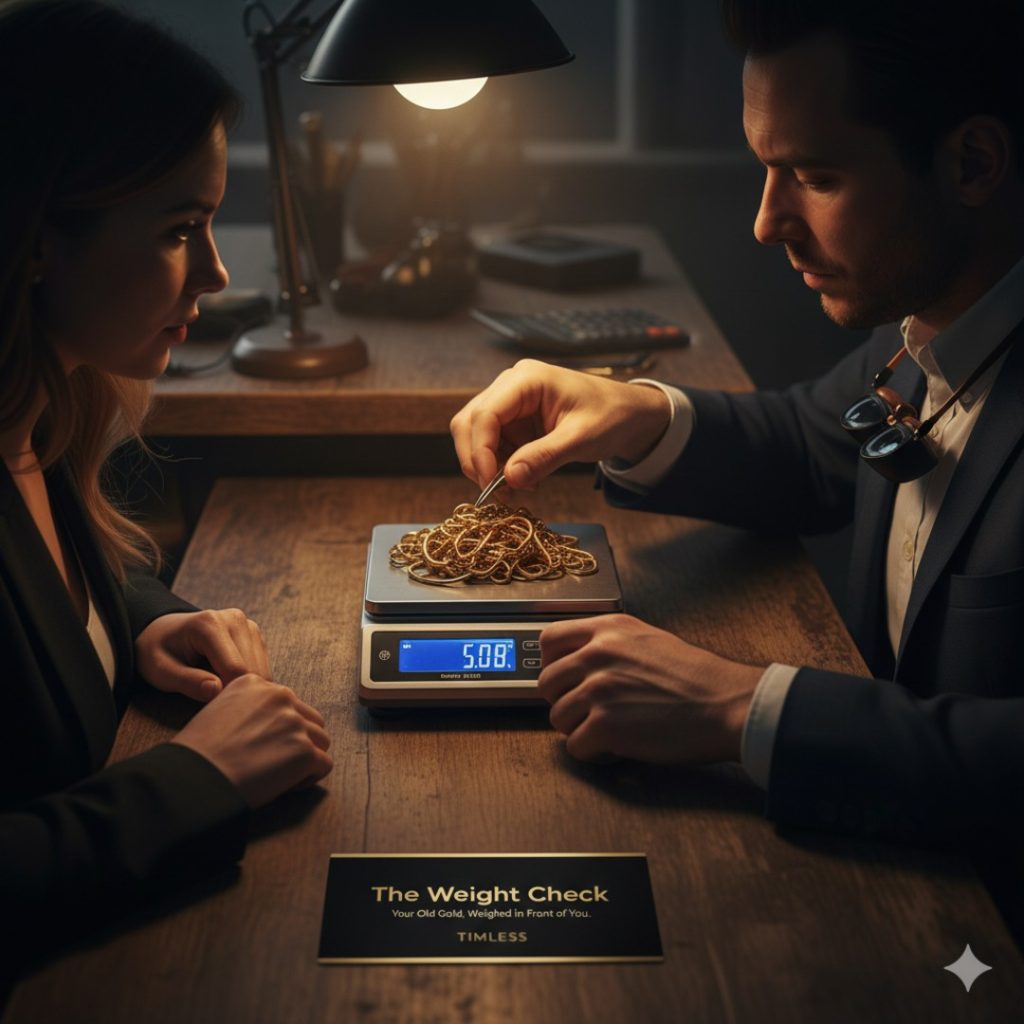
The jeweler will weigh your old gold in front of you.
- Watch Out: Ensure the scale is set to zero. Remove any threads, dori (strings), or wax filled inside bangles before weighing.
Step 2: The Purity Check (The Karatometer)

This is the moment of truth.
- Hallmarked Gold: If your old jewelry has the BIS 916 stamp, you are safe. Most top jewelers (Tanishq, Malabar, Kalyan) will give you 100% exchange value for 22k Hallmarked gold.
- Non-Hallmarked Gold: If your gold is old and unstamped, the jeweler will put it in a Karatometer (XRF machine). It scans the surface to tell the purity (e.g., 18k, 20k, or 22k).
- The Melting Pot: Sometimes, the Karatometer isn’t accurate for deep layers. The jeweler might ask to melt your gold to check the core purity. Only agree to this if you are 100% sure you want to exchange. Once melted, there is no going back.
Step 3: The Valuation

Formula: (Weight – Stone Weight – Dirt) x Current Gold Rate x Purity %
- If you have 10 grams of 22k gold, and the rate is ₹7,000/g:
- You get credit for ₹70,000.
- You use this ₹70,000 credit to buy new jewelry.
The “Zero Deduction” Myth
You will see ads screaming: “0% Deduction on Old Gold Exchange!” Is it real? Yes, but read the fine print.
Usually, “0% Deduction” applies ONLY if:
- The old gold is 22k BIS Hallmarked.
- You are buying Diamond or Polki Jewellery (which has high profit margins for them).
If you bring in old, non-hallmarked gold, expect a deduction of 2% to 4% towards “melting loss.” This is standard industry practice. Don’t fight it, but ensure it doesn’t cross 4%.
The “Stone” Heartbreak
This is the hardest pill to swallow. Remember those beautiful rubies and emeralds in your grandmother’s necklace? They are valued at ZERO.
When you exchange studded jewelry:
- The jeweler removes the stones (or estimates their weight).
- They deduct the stone weight from the total weight.
- You get paid only for the net gold weight.
- The stones are returned to you (often broken or chipped during removal).
Strategy: If you have heavy Kundan or Polki pieces, do not exchange them. The loss is too high because 30% of the weight is stones/wax. Keep those as heirlooms. Only exchange plain gold or simple chains.
Smart Exchange Strategy: How to Win
Follow these rules to ensure you don’t get cheated.
1. The “Clean Up” Rule
Dirt, oil, and soap accumulate in old jewelry chains.
- Before you go: Soak your old gold in warm soapy water and brush it clean.
- Why: Jewelers deduct 0.1g or 0.2g for “dirt.” If your gold is clean, you can argue against this deduction.
2. Bring the Old Bill
If you have the original invoice, take it. It proves the purity and source. It makes the negotiation smoother, especially for non-hallmarked pieces.
3. Negotiate the “New” Making Charges
The jeweler makes his profit on the new jewelry you buy.
- Since you are giving him business (and gold stock), you have leverage.
- The Ask: “I am exchanging 50 grams of gold. I want a 25% discount on the Making Charges of the new necklace.”
- They will almost always agree to this.
Pro Tip:
The “Gold Rate” Trap Check the Buying Rate vs. Selling Rate. Jewelers have two rates on the board.
- We Sell at: ₹7,200/g
- We Buy at: ₹7,000/g When you exchange, they value your old gold at the “Buy” rate (lower) and sell you new gold at the “Sell” rate (higher). The Fix: Look for “One Rate” offers during festivals like Akshaya Tritiya or Diwali, where they value your old gold at the Selling Rate. This saves you thousands of rupees.
What to Upgrade To? (2025 Trends)
So, you have traded in your grandma’s heavy choker. What should you get? Don’t make the same mistake of buying something heavy again. Buy Wearable Gold.
- Trade: Heavy Gold Chain -> Get: Rose Gold Diamond Bracelet.
- Trade: Old Heavy Earrings -> Get: Solitaire Studs + Lightweight Daily Chain.
- Trade: Outdated Bangles -> Get: A Modern “Watch Charm” or Stackable Rings.
Conclusion: Unlock Your Wealth
Your gold should make you feel beautiful, not burdened. If you have pieces you haven’t worn in 3 years, they are just metal lumps. Take them to the store. Watch them melt. And turn them into something that represents who you are today.
The Gold Jewellery Exchange Offer is your ticket to a wardrobe refresh. Just keep your eyes on the scale, your calculator in hand, and your heart set on that new design.
I’d love to know: What is the oldest piece of jewelry you own that you never wear? Are you planning to exchange it? Let me know in the comments below!
Frequently Asked Questions (FAQs)
Can I exchange gold from one jeweler at another shop?
Yes, absolutely. Gold is a universal currency. You can buy from Tanishq and exchange it at Malabar (or vice versa). However, the new jeweler will strictly test the purity. If it is Hallmarked, you will get the full rate. If not, they might deduct a melting percentage.
Do I have to pay tax (GST) on gold exchange?
You do not pay tax on the old gold you give. However, you have to pay 3% GST on the value of the new gold you buy and 5% GST on the making charges.
Example: You give old gold worth ₹50k. You buy new gold worth ₹60k. You pay the difference (₹10k) + GST on the full ₹60k transaction value (rules vary slightly by state/jeweler interpretation, but usually, GST is on the gross invoice value).
Will I get money for the stones in my old jewelry?
No. 99% of jewelers will value semi-precious stones (rubies, emeralds, zircon) at zero. Even for diamonds, unless you have a GIA certificate or exchange it at the same jeweler you bought it from, the exchange value is very low (often just 70-80% of current diamond value).
What is the best time to exchange gold?
The best time is during “Grand Exchange Festivals” run by big brands (usually June-July or pre-Diwali). During these times, they often offer:
0% Deduction on old gold.
Flat discounts on making charges.
One Rate (Buying rate = Selling rate)