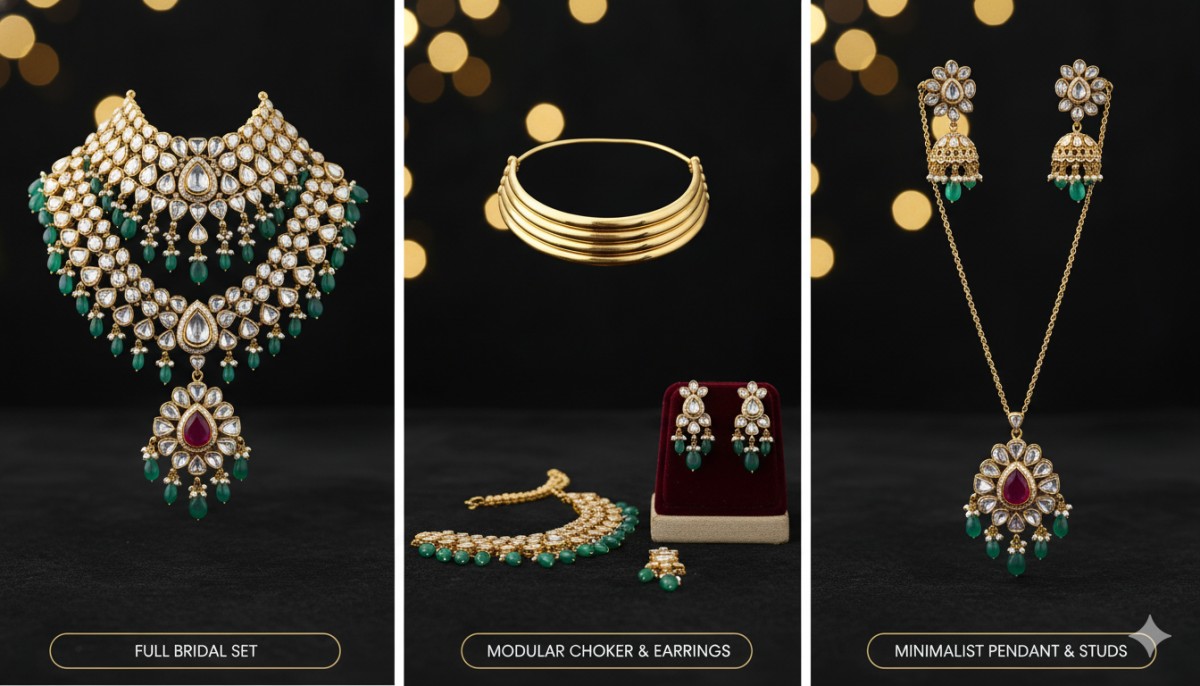
In an era where sustainability, minimalist living, and maximizing utility are paramount, jewelry design has evolved to embrace versatility. Detachable Gold Jewellery Sets represent the pinnacle of this smart luxury trend. These pieces are ingeniously engineered to transform, allowing one single necklace set to be worn in multiple distinct ways—most commonly as a long Haram, a tight choker, and often converting components into earrings or bracelets.
The promise of 1 Necklace, 3 Ways to Wear offers unprecedented value, style flexibility, and investment efficiency. This innovation allows the wearer to transition seamlessly from a heavy bridal look to simple office wear, making high-karat gold accessible and practical. This comprehensive guide explores the structural brilliance, the core design transformations, and the investment reasons why detachable gold jewellery is the future of fine ornamentation.
Read more: The “Waterfall” Effect: Styling 3 Gold Necklaces
1. The Rise of Versatility: Maximizing Value and Utility
The modern consumer, particularly in the Indian market, seeks value beyond weight and purity. Detachable jewelry addresses several key lifestyle demands:
A. Investment Efficiency
Detachable sets mitigate the need to purchase multiple heavy pieces. The investment in one meticulously crafted set provides the visual impact of several, significantly reducing the overall budget required for a comprehensive wardrobe.
B. Travel and Convenience
For travel or destination weddings, detachable sets simplify packing. One primary piece provides options for every event (Sangeet, Wedding, Reception) while minimizing weight and risk during transit.
C. Style Transition
The ability to quickly transform a piece allows the wearer to adapt to different social settings—from the highly traditional demands of a family Pooja (requiring a long, heavy Haram) to the sleek, modern aesthetic of a formal reception (requiring a tight choker).
2. The Engineering of Transformation: How Detachment Works
The success of these versatile pieces lies in the robust, discreet, and reliable mechanisms used to connect and separate the gold components.
A. Secure Screw Pins and Latches
The core mechanism involves small, precision-engineered screw pins or secure latches (often disguised as design elements). These allow heavy central pendants or multi-strand bead sections to be removed or re-attached securely without needing a jeweler.
B. Dual-Purpose Components
Often, the central pendant features a small hidden hook or pin on the back, allowing it to detach from the chain and be worn separately as an oversized brooch or hair accessory.
C. Interchangeable Clasps and Hooks
Many sets include specialized clasps that can hook onto an adjacent link further up the chain, effectively shortening the necklace by half its length to create a choker.
3. The Core Promise: 1 Necklace, 3 Ways to Wear (Design Breakdown)
The versatility of the detachable set is most apparent in its ability to fulfill three fundamental jewelry needs with a single investment.
Way 1: The Long Haram (Maximum Volume)
- Configuration: The full necklace worn at its maximum length (24–30 inches), often featuring a heavy traditional pendant (Taveez or deity motif) at the end.
- Aesthetic: Traditional, bridal, or grand festive wear.
Way 2: The Choker or Collar (Neckline Focus)
- Configuration: The Haram is separated into sections. The top, ornate collar piece (often Kundan-set) detaches and is worn as a rigid choker (14–16 inches). The lower sections and the long chain are temporarily removed.
- Aesthetic: Modern, structured, and perfect for high-neck blouses or formal gowns.
Way 3: Bracelet and Earring Set (Secondary Utility)
- Configuration: This is the most brilliant transformation. The long chain sections (often detachable in 8–10 inch segments) are rejoined to form a bracelet. Simultaneously, the two ornate side pieces that flank the main pendant detach to be worn as large statement earrings or Jhumkas.
- Aesthetic: Practical, providing necessary accent pieces to complete an evening look while utilizing every gold component.
4. Top Detachable Designs and Styles
Detachable designs are not limited to traditional heavy pieces; modern minimalist styles also utilize the transformation principle.
A. The Traditional Haram-to-Choker Set
This classic model splits the main necklace into a short choker (top half) and a long Haram pendant (bottom half). The detachable center pendant can be hooked onto the choker, or worn at the base of the long chain.
B. The Pendant-to-Brooch/Hair Accessory
This design focuses on the central motif (often a large floral or deity piece). The pendant detaches and features a secure, hidden brooch pin on the back, allowing the piece to be worn on a saree shoulder or dupatta.
C. Kundan and Pearl Convertible Sets
These popular sets use pearls and small beads to connect the gold units. The multiple strands of pearls can be detached and reconfigured. The gold spacers (often Kundan-set) can be worn as standalone earrings.
5. Purity, Structural Integrity, and Investment
Structural reliability is paramount in detachable jewelry; therefore, the metal purity and construction must be superior.
A. 18K Gold for Mechanisms
18K gold is superior for detachable components. Its increased hardness over 22K gold ensures the screw pins, clasps, and small hooks maintain their integrity, preventing threads from stripping or latches from bending, which would compromise the security of the entire set.
B. BIS Hallmarking of Components
When purchasing a detachable set, ensure every significant gold component (the main pendant, the choker section, and the long chain sections) carries the mandatory BIS hallmark. This guarantees the purity of the entire investment.
C. Investment Value
The investment in a detachable set is highly cost-effective because the ‘making charges’—which are often the highest cost factor—are distributed across three or more unique jewelry looks. This maximizes the utility return on the labor investment.
Conclusion
Detachable Gold Jewellery Sets are revolutionizing how women approach luxury, offering a powerful blend of traditional investment and modern convenience. By mastering the engineering behind the transformations—from a long Haram to a simple choker and into a coordinated set of earrings and bracelets—the wearer embraces a smart, sustainable approach to style that guarantees 1 Necklace, 3 Ways to Wear and makes every gram of gold work harder.
Frequently Asked Questions (FAQs)
Are detachable gold pieces more prone to breaking or coming apart?
Not if they are high-quality. Reputable jewelers use precision-engineered screw pins and secure safety latches that are stronger than traditional friction hooks. Choosing 18K gold for the mechanism also minimizes the risk of bending or breaking.
How do I clean detachable gold jewellery?
Clean the pieces while they are fully assembled. Only detach the components when you need to separate the long chains from the pendants. Clean with mild soap and water, and ensure all screw pins are completely dry before reassembling.
Is the conversion process easy enough to do at home?
Yes. Good detachable designs are engineered to be simple and intuitive, allowing the wearer to switch configurations quickly at home without needing any tools or professional assistance.
Does the ‘making charge’ increase significantly for detachable sets?
Yes, the initial making charge is higher due to the complex engineering and labor involved in precision fitting the mechanisms. However, the cost-per-wear is drastically reduced since one set fulfills multiple needs.
Should all parts of a detachable set have the BIS hallmark?
Yes. Any component in the set that weighs a significant amount of gold (such as the main pendant, the choker section, and the main chain) must carry the BIS hallmark to guarantee the purity of the entire investment.