If you have ever visited the misty hills of Coorg (Kodagu) in Karnataka, you know that the culture there is unlike anything else in India. From their warrior traditions to their unique way of draping a saree (pleats at the back!), the Kodavas are a distinct and proud community.
But for a jewelry lover like me, the real magic of Coorg lies in its gold.
Among all their treasures—the Pathak (symbol of marriage) and the Jomale (beaded chain)—there is one piece that stands out for its sheer artistic beauty: the Kokkethathi.
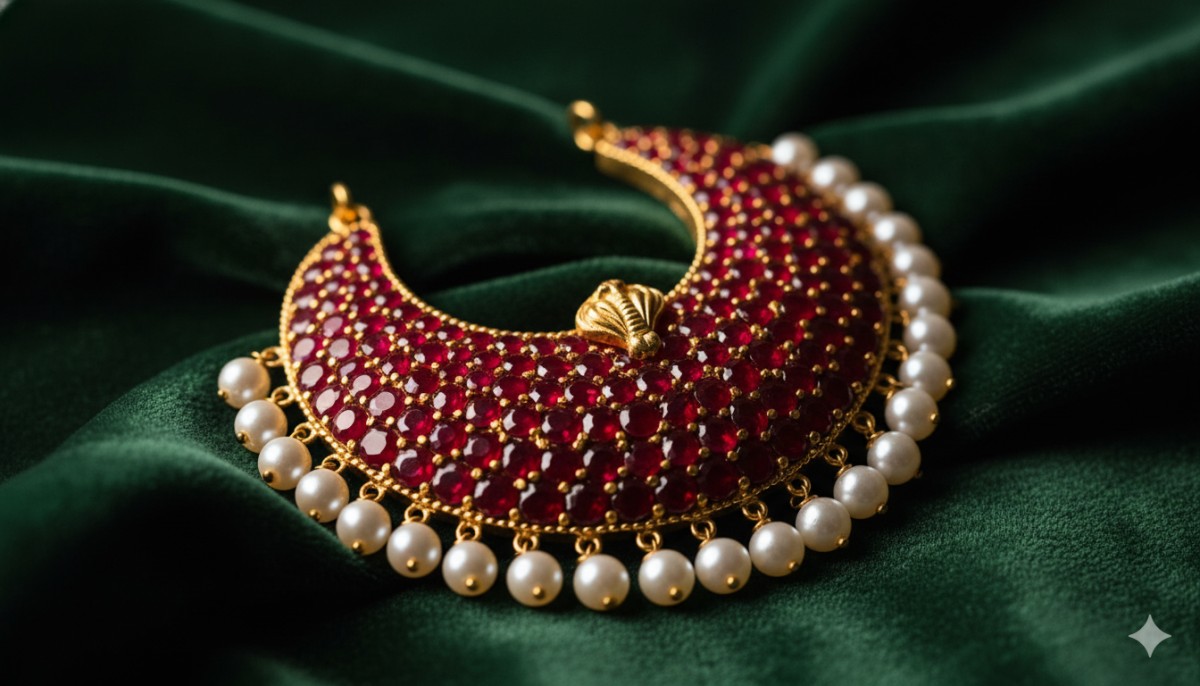
It is that stunning, crescent-shaped pendant studded with red rubies and framed by pearls, usually hanging from a chain of gold beads. It is majestic, it is feminine, and it is steeped in symbolism.
Whether you are a Kodava bride-to-be or just someone who loves collecting heritage Indian jewelry, the Coorgi Kokkethathi is a masterpiece you need to know about. In this guide, I’m going to take you through its hidden meanings, how to spot a real one, and why this crescent moon belongs in your jewelry box.
Read more: Fingerprint Impression Gold Rings
What is the “Kokkethathi”?
Let’s start with the name. In the Kodava language:
- “Kokke” means “Hook” or “Crooked” (referring to the curved crescent shape).
- “Thathi” means “Jewel” or “Ornament.”
So, literally, it is the “Curved Jewel.” But poetically, it represents the Crescent Moon.
While the Pathak is mandatory for a married woman (like a Mangalsutra), the Kokkethathi is worn for beauty and prosperity. It is traditionally worn by a bride on her wedding day, but here is the best part: it is not restricted to married women. Young girls and unmarried women can wear it too, making it a versatile piece of heirloom jewelry.
The Design: A Cobra in the Moon
At first glance, it looks like a simple half-moon set with red stones. But look closer. The design is incredibly complex and meaningful.
1. The Crescent (The Moon)
The bottom half is the crescent moon. In many cultures, the moon represents feminine energy, fertility, and coolness. For a bride entering a new phase of life, this symbol is a blessing for a calm and fruitful life.
2. The Hood (The Cobra)
This is the detail most people miss! At the very top of the pendant, where it connects to the chain, there is often a motif of a Cobra spreading its hood. Coorgis are nature worshippers, and the worship of the Snake God (Subramanya or Natta) is a huge part of the culture. The snake symbolizes protection. So, the Kokkethathi isn’t just pretty; it’s a talisman protecting the wearer from harm.
3. The Stones (Rubies and Pearls)
- Rubies (Kemp): The body of the pendant is filled with graduated cabochon rubies (pinkish-red stones). Red represents vitality and life.
- Pearls (Muthu): The bottom rim of the crescent is fringed with bunches of small hanging pearls. These add movement and grace to the heavy gold piece.
Traditional vs. Modern: Which One is For You?
As an editor, I have seen this design evolve. Depending on your taste (and budget), you have two main routes.
The “Old Gold” Antique Style
This is the purist’s choice.
- Look: The gold has a reddish, antique finish (Geru finish).
- Setting: The rubies are set using a traditional “Lac” (Wax) method. The stones are embedded in a natural resin within the gold casing.
- Vibe: It looks earthy, regal, and vintage. This is what you wear with the traditional Kodava saree or a heavy Kanjeevaram.
The Contemporary “Light” Style
- Look: Bright yellow 22k gold with a shiny finish.
- Setting: The stones are set using modern prong or bezel settings (open back), which allows light to pass through the rubies.
- Vibe: It is flashier and sparkles more. It works well with fusion wear, like a silk gown or a chiffon saree.
[Link to related post: Antique vs. Yellow Gold: Which Finish Suits Indian Skin Tones?]
The “Gund” Chain: The Perfect Partner
You cannot talk about the Kokkethathi without talking about the chain it hangs on. Traditionally, this pendant is strung on a chain made of “Gunds” (Gold hollow beads).
- The Hollow Bead: These beads are lightweight but look large.
- The Black Thread: Often, the beads are strung on a black thread or mixed with black beads (Karimani), which wards off the evil eye.
When you buy a Kokkethathi, you are usually buying the whole set: the pendant plus the Gund chain.
Buying Guide: Weight and Purity
This is the technical part. Don’t get tricked by the size!
1. The “Wax” Factor
In traditional South Indian temple jewelry, the gold weight might be less than you think. Because the stones are set in Lac (Wax), a significant portion of the pendant’s weight is actually wax and stones, not gold.
- Ask the Jeweler: “What is the Net Gold Weight?” and “What is the Gross Weight?”
- Price: You should only pay the gold rate for the Net Gold Weight. The stones and wax should be priced separately (and usually much cheaper).
2. Standard Weights
- Small/Light Pendant: 10 to 15 grams of gold.
- Medium Bridal Pendant: 20 to 30 grams of gold.
- Heavy Heritage Piece: 40 to 60 grams of gold (including the heavy bead chain).
3. Purity
Always insist on BIS Hallmarked 22k Gold (916). Even if it is an antique design, the metal purity should not be compromised.
Pro Tip: Check the Hook! The “Kokkethathi” is a heavy pendant. Ensure the loop (hook) at the top is thick and reinforced. Over years of wearing, the friction between the heavy pendant and the chain can cut through a thin gold loop. Ask for a “double-soldered” loop for safety.
Styling the Kokkethathi Outside Coorg
You don’t have to be Coorgi to wear this beauty. Here is how I style it for my clients who want a unique look.
1. The Layering Game
Use the Kokkethathi as your “mid-length” necklace.
- Layer 1: A tight gold choker or a simple chain.
- Layer 2: The Kokkethathi (sitting on the chest).
- Layer 3: A long Haraam or Mango Mala. The crescent shape breaks the monotony of round necklaces and adds a sharp, geometric element to your stack.
2. The Solo Statement
Wear a solid black or deep bottle-green silk saree. No other necklaces. Just the Kokkethathi. The red rubies against a dark fabric look absolutely striking. It is sophisticated and commands attention.
3. Fusion Power
Believe it or not, I have seen brides wear a Kokkethathi with a velvet Anarkali suit. The pendant acts like a statement brooch-necklace. It adds that “Old India” charm to a modern outfit.
[Link to related post: 5 South Indian Temple Jewelry Designs That Are Trending Globally]
Maintenance: Caring for Rubies and Pearls
This pendant has organic stones (pearls) and often wax setting, so you have to be careful.
- No Hot Water: Never dip a wax-filled (Lac) jewelry piece in boiling hot water. The wax can melt or expand, loosening the stones. Use lukewarm water only.
- Perfume First: Spray your perfume before wearing the necklace. Chemicals can dull the pearls and change the color of the rubies over time.
- Storage: Wrap it in cotton or a soft muslin cloth. Do not use velvet boxes for long-term storage of pearls, as they need to “breathe.”
Conclusion: A Curve of Culture
The Coorgi Kokkethathi is more than just gold. It is a tribute to nature, a prayer for protection, and a celebration of womanhood.
In a market flooded with generic laser-cut designs, wearing a Kokkethathi sets you apart. It shows you appreciate heritage. It shows you have an eye for the unique. Whether you inherited one from your grandmother or are planning to buy your first, wear it with pride. You are carrying a piece of the misty Kodagu hills close to your heart.
I’d love to hear from you: Have you ever attended a Coorgi wedding? What was the one piece of jewelry that caught your eye? Tell me in the comments below!
Frequently Asked Questions (FAQs)
Is the Kokkethathi the same as a Mangalsutra?
No. For Coorgis, the symbol of marriage is the “Pathak” (a gold coin with Lakshmi or Queen Victoria engraved, surmounted by a cobra). The Kokkethathi is a traditional ornament worn for beauty and status, though it is a staple for brides. Unmarried women can also wear a Kokkethathi.
How much does a Kokkethathi cost?
It depends on the gold weight and the quality of rubies.
A light version (15g gold + stones): Approx ₹1.2 Lakh to ₹1.5 Lakh.
A heavy bridal version (40g gold + stones): Approx ₹3.5 Lakh to ₹4.5 Lakh.
Why do some Kokkethathi pendants look dull/reddish?
That is the “Antique” or “Geru” polish. It is done intentionally to make the jewelry look vintage and earthy. It helps the red color of the rubies pop. If you prefer shiny gold, ask your jeweler for “Yellow Polish.”
Can I get a Kokkethathi in 18k gold?
Yes, you can. If you want to reduce the cost or if you want a more durable piece for daily wear, 18k is a great option. However, for heirloom value and resale, 22k is preferred in India.
Are the pearls real?
In high-end pieces, jewelers use Basara pearls or good quality freshwater pearls. In budget-friendly versions, they might use shell pearls or imitation pearls. Always ask the jeweler for a certificate if you are paying for real pearls.