Maybe it was a crowded coffee shop in Bandra where you bumped into someone and spilled your chai. Maybe it was a quiet bench in a university campus in Delhi. Or perhaps, it was the specific Mandap in a banquet hall where you took your seven vows.
We often remember the date (anniversaries are hard to forget), but we rarely celebrate the place.
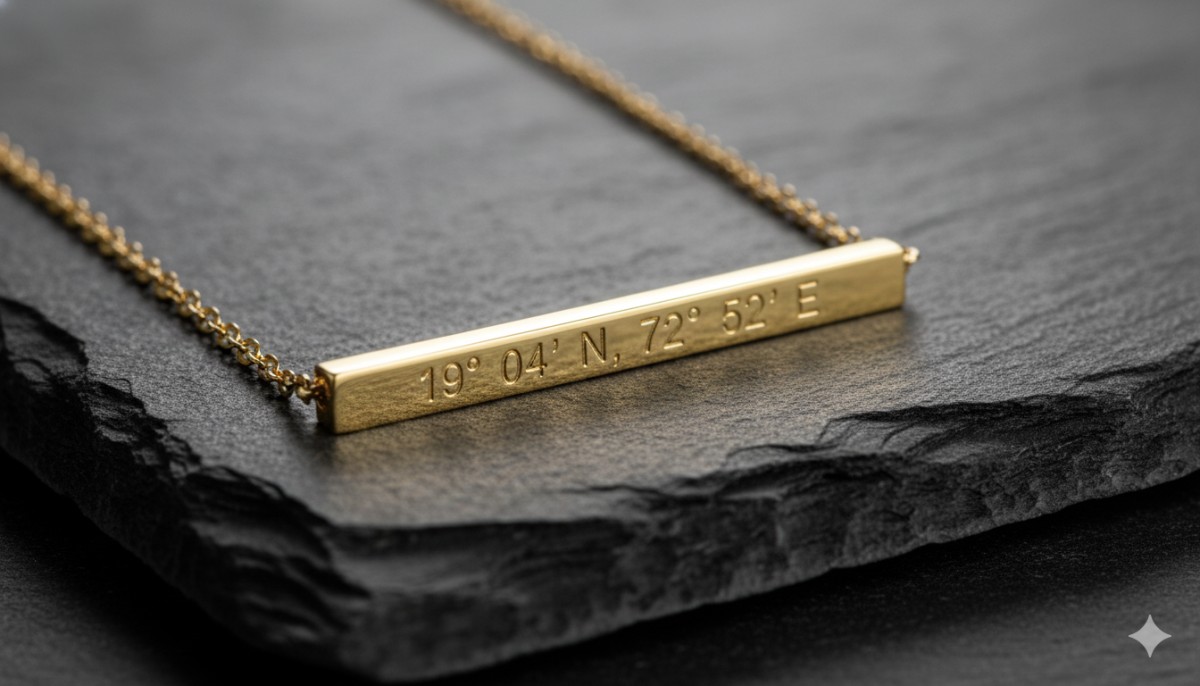
That is changing. The biggest trend in personalized luxury right now is Coordinate Jewellery. It is the art of taking the specific Latitude and Longitude of a meaningful location—a string of numbers like 19°04’N, 72°52’E—and engraving them onto a piece of solid gold.
To a stranger, it looks like a mysterious code or a random set of numbers. But to you? It is “X marks the spot.” It is a secret map to a memory that only the two of you share.
As a jewelry editor, I love this trend because it is Minimalist yet Maximalist. The design is simple (minimal), but the emotional weight it carries is huge (maximal). In this guide, I’ll walk you through how to find your coordinates, the best gold designs to engrave them on, and the technical tricks to ensure the numbers remain sharp forever.
Read more: Grandma’s “Attigai” Necklace
Why Coordinates? The Rise of “Secret” Luxury
We are living in an era of over-sharing. Everyone knows everything about us on social media. This has created a craving for privacy—for things that are just for us.
Name necklaces (like “Priya” or “Rahul”) are beautiful, but they are obvious. Everyone can read them.Coordinate Jewellery is subtle.
- The Mystery: When someone asks, “What do those numbers mean?”, you have the choice to share the story or just smile and say, “It’s a special place.”
- The Precision: A city name like “Mumbai” is vague. But a coordinate points to the exact bench where he proposed. It captures the precision of the memory.
5 Locations Worth Engraving
If you are wondering, “What spot should I choose?”, here are the most popular requests I get from clients:
1. The “First Meet” Spot
The classic choice. The restaurant, the library, or the street corner where you first laid eyes on each other.
2. The “I Do” Location
For married couples, the exact coordinates of the wedding venue. This is a popular anniversary gift.
3. The “First Home”
Buying a house is a massive milestone in India. Engraving the coordinates of your first home on a keychain or a pendant is a beautiful way to honor that achievement.
4. The “Roots” (Ancestral Village)
I have seen many NRIs (Non-Resident Indians) engraving the coordinates of their grandfather’s village in Punjab or Kerala. It’s a way to stay grounded and connected to their heritage, no matter where they live in the world.
5. The “Bucket List” Memory
That one cliff in Switzerland where you paraglided, or the beach in Bali where you realized you were in love.
The Technical Guide: Engraving on Gold
You cannot just scratch numbers onto a ring and hope for the best. Numbers are intricate. If the engraving is poor, a “3” will look like an “8” within a year.
1. Laser vs. Hand Engraving
For Coordinate Jewellery, Laser Engraving is the only way to go.
- Precision: Coordinates often have tiny symbols like degrees (°), minutes (‘), and seconds (“). A hand engraver might struggle to make these clear on a small ring. A laser burns them in with microscopic accuracy.
- Depth: Ask your jeweler for “Deep Laser Engraving.” If it is too shallow, it will rub off with daily wear.
2. The Font Matters
- San Serif (Block) Fonts: Best for numbers. Clean, modern, and readable. (e.g., Arial, Helvetica style).
- Serif/Script Fonts: Avoid these for coordinates. The swirls and loops make the numbers hard to read. You want the code to look like a scientific instrument—sharp and clean.
3. Gold Purity: 18k is the Hero
I will sound like a broken record, but for engraved jewelry, 18k Gold is superior to 22k.
- The Reason: 22k gold is soft. Over time, the metal “moves” slightly with friction. The sharp edges of your engraved numbers will smooth out and blur.
- 18k Gold: It is harder. It holds the crisp definition of the engraving for decades.
Popular Design Styles
The Horizontal Bar Necklace
This is the most popular style for women. A sleek, rectangular bar of gold (about 30mm long) with the coordinates engraved across it.
- Styling: Looks incredible layered with a shorter diamond solitaire.
The “Band” Ring
Perfect for men. A matte-finish gold band with the coordinates engraved on the inside (for privacy) or the outside (for style).
- Texture: Try a “Hammered Finish” band with a smooth strip for the numbers. The contrast is stunning.
The Vertical Drop Pendant
Instead of a horizontal bar, a vertical stick pendant. The coordinates are engraved vertically (top to bottom). This has a very modern, slimming effect on the neckline.
The Cuff Bracelet
A solid gold or silver bangle with the coordinates engraved on the top surface. This is a great unisex option.
How to Find Your Exact Coordinates (Step-by-Step)
You don’t need a GPS device. You just need your phone.
- Open Google Maps.
- Zoom in to the exact spot (the specific building or street corner).
- Right-click (on desktop) or Long-press (on mobile) on the spot.
- A grey pin will drop.
- Look at the search bar or the bottom of the screen. You will see a string of numbers (e.g., 28.6139° N, 77.2090° E).
- Copy these exactly. Send them to your jeweler.
Pro Tip: Decimal vs. DMS. There are two formats.
- Decimal: 28.6139, 77.2090 (Modern, digital look).
- DMS (Degrees, Minutes, Seconds): 28° 36′ 50″ N, 77° 12′ 32″ E (Classic, nautical, vintage look).
My advice: Choose the DMS format for jewelry. The little circles and tick marks (° ‘ “) look much more artistic and “jewelry-like” than simple decimals.
Gift Guide: When to Give This?
This is not a casual gift. It is deep.
- Long Distance Relationships: Engrave your location on a ring for them, so they always know where you are.
- 1st Anniversary (Paper/Clock) or 50th Anniversary (Gold): It signifies the journey of time and place.
- Graduation: The coordinates of the university where they earned their degree.
Cost and Budgeting
Since these are usually custom-made, expect to pay for the gold weight plus a customization fee.
- Bar Necklace (4-5 grams 18k): Approx ₹30,000 – ₹40,000.
- Ring (6-8 grams 18k): Approx ₹45,000 – ₹55,000.
- Laser Engraving Charge: Usually ₹1,000 – ₹2,000 extra.
Conclusion: Grounding Your Memories
We move around a lot. We change cities, we change houses, we change jobs. But some places stay etched in our souls forever.
Coordinate Jewellery is a way to physicalize that feeling. It turns a fleeting memory into 18 karats of permanence. It says, “No matter where we go, this is where it started.”
So, pull out your map. Find that spot where your heart skipped a beat. And turn that dot on the map into a piece of gold you can wear close to your heart every single day.
I’d love to know: If you could engrave one location on a ring right now, where would it be? The place you were born, or the place you met your love? Tell me in the comments!
Frequently Asked Questions (FAQs)
Can I engrave coordinates on a very thin ring?
It is risky. If the ring is thinner than 2mm, the numbers will be too small to read without a magnifying glass. I recommend a band width of at least 3mm to 4mm to make the text legible and sharp.
Can I engrave two locations on one piece?
Yes! A popular design for long-distance couples is the “Two-Sided Bar Necklace.” You engrave your location on the front, and your partner’s location on the back. Or, on a ring, you can stack the two coordinates on top of each other if the band is wide enough.
Will the black ink inside the engraving fade?
Often, jewelers fill the laser engraving with black enamel to make the numbers pop. Yes, this enamel can fade over 2-3 years with soap and water exposure. However, the grooves of the laser are permanent. You can take it back to the jeweler to get the black color refilled for a nominal cost.
Is it better to use Roman Numerals for coordinates?
Roman Numerals (I, V, X) work for dates, but they are terrible for coordinates. Coordinates are complex mathematical numbers. Converting “28° 36′ 50″” into Roman numerals would result in a string of text so long it wouldn’t fit on a necklace. Stick to standard Arabic numerals (1, 2, 3).