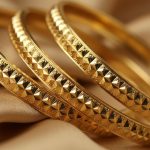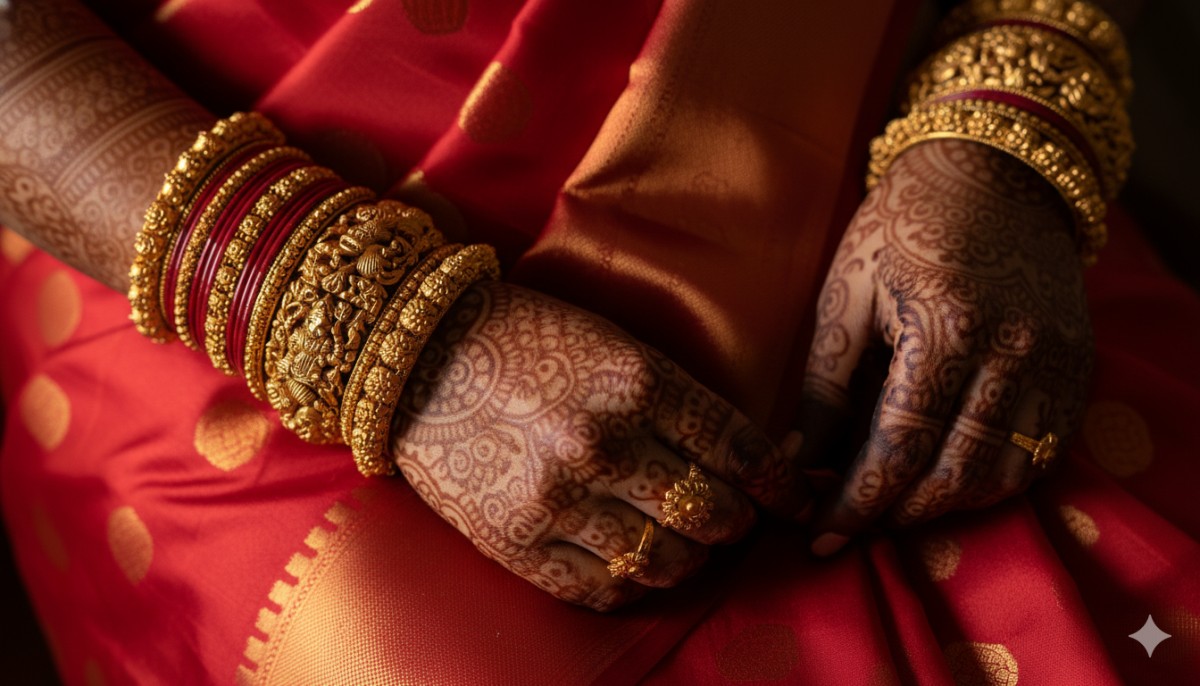
Close your eyes and imagine the sound of an Indian wedding. The Shehnai playing, the laughter, and the distinct clink-clink of heavy gold bangles striking against each other.
For an Indian bride, her hands are the canvas of her love story. The Mehndi tells the story, but the Antique Gold Kangans (Bangles) provide the royal frame.
In 2025, we are witnessing a massive shift. The era of delicate, diamond-cut bangles is taking a backseat. The “Maharani Aesthetic” is back. Brides want jewelry that looks like it was stolen from a 10th-century Chola temple or inherited from a royal grandmother. They want Temple Jewellery.
These aren’t just bangles; they are sculptures in gold. They carry the weight of tradition (literally and metaphorically) and feature the reddish-antique glow that defines South Indian heritage.
In this guide, I will take you into the world of Nakshi work, divine motifs, and heavy gold weights. If you are a bride-to-be, this is your bible for choosing the perfect Antique Kangans that will stay in your family for generations.
Read more: Matte Finish Gold Jewellery
What Makes a Kangan “Antique”?
First, let’s clear the confusion. You walk into a store, and you see “Yellow Gold” and “Antique Gold.” What is the difference?
- Yellow Gold: This is bright, shiny, and reflects light like a mirror.
- Antique Gold: This is 22k Gold that has been treated with a special “Geru” (reddish) or “Black Oxidized” polish.
Why do we do this? Temple jewelry is all about 3D Carving (Nakshi). If you carve a complex figure of Goddess Lakshmi on bright yellow gold, the reflection is so high that you can’t see the details. By darkening the crevices with antique polish, the design pops out. The shadows created by the polish give the bangle depth, character, and that “ancient” look.
The Holy Trinity of Temple Motifs
When shopping for Antique Kangans, you won’t find geometric shapes or modern lines. You will find symbols that have spiritual meaning.
1. The Divine Lakshmi (Ashta Lakshmi)
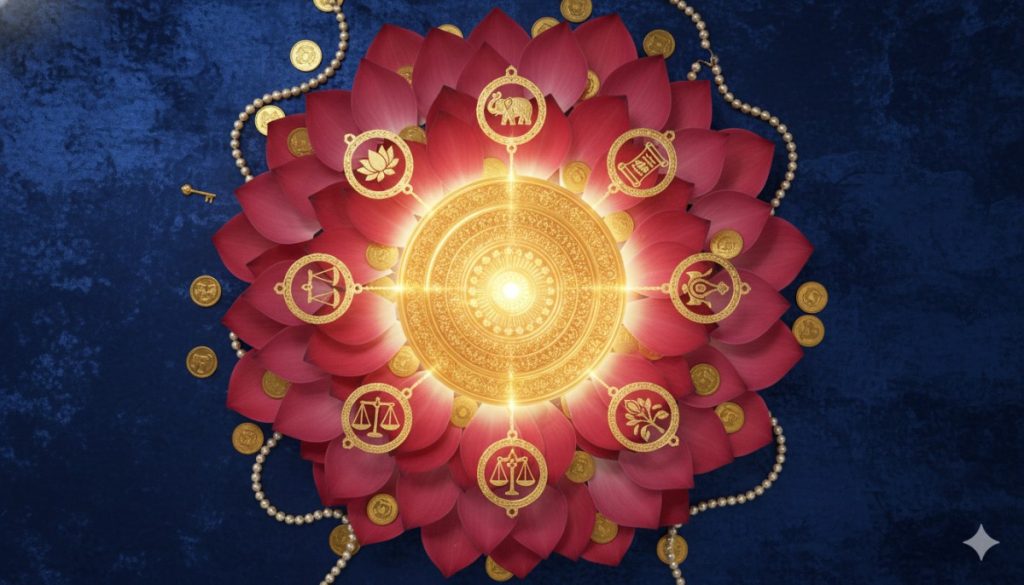
This is the quintessential bridal choice.
- The Design: The bangle features eight forms of Goddess Lakshmi sitting on a lotus, repeated around the wrist.
- The Meaning: It represents the eight forms of wealth (Health, Money, Knowledge, Courage, etc.). Wearing this on your wedding day invokes prosperity for your new home.
2. The Regal Peacock (Mayura)
- The Design: Two peacocks facing each other at the screw-opening of the bangle, or a procession of peacocks dancing around the band.
- The Meaning: Beauty, grace, and love. In many cultures, the peacock is the vehicle of Lord Kartikeya and a symbol of protection.
3. The Royal Elephant (Gaja)
- The Design: A row of marching elephants.
- The Meaning: Strength, wisdom, and royalty. In ancient times, only royalty rode elephants. Wearing this symbolizes the bride’s entry into her new life with grandeur.
Types of Antique Kangans: Which One Fits You?
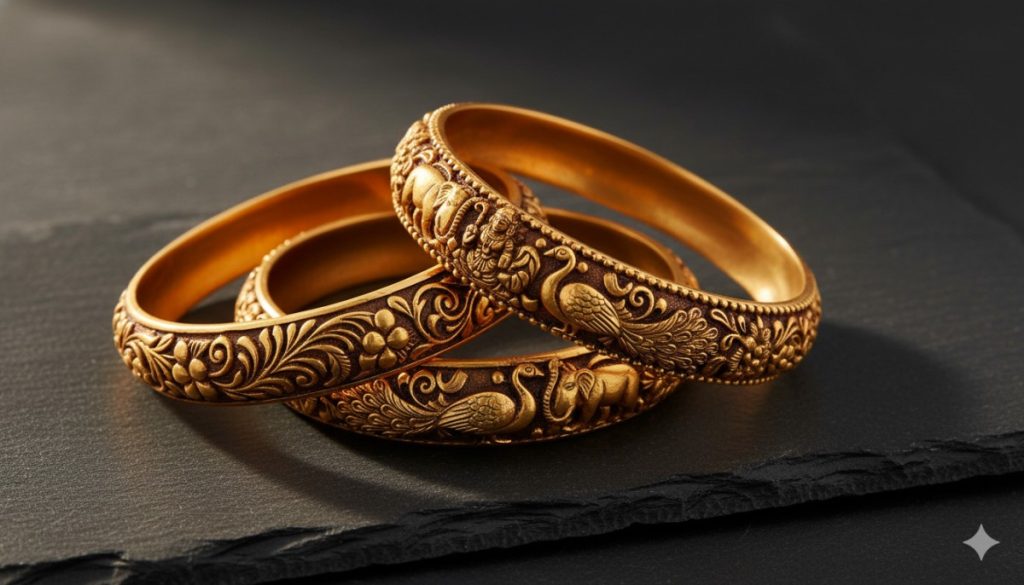
Not all Kangans are the same. The structure matters for comfort and fit.
1. The “Screw” Kangan (Thirugani)
These are the heavy-hitters.
- Structure: They are stiff, openable bangles with a screw mechanism on the side.
- Why choose this: You can buy a tighter fit because the screw allows you to open it wide to put it on. It sits snugly on the wrist without sliding up and down.
2. The “Gajra” Bangle
Named after the flower garland.
- Structure: This Kangan has little gold bubbles or “Rawa” balls protruding all around, resembling jasmine buds.
- Why choose this: It adds massive volume. If you wear just two Gajra Kangans, your hand looks full. You don’t need a dozen glass bangles.
3. The “Kemp” Studded Kangan
This brings color to the gold.
- Structure: Heavy gold antique base studded with Spinels (Rubies) and Emeralds.
- Why choose this: The matte red stones (Kemp) look stunning against the reddish antique gold. It breaks the monotony of plain metal.
Antique Kangans are not lightweight jewelry. They require a thick sheet of gold to support the deep carving (Nakshi work). If the gold sheet is too thin, the hammering will puncture it.
- Minimum Weight: A good, durable single Antique Kangan starts at 20 to 25 grams.
- Bridal Weight: A heavy, broad “Kada” with deep Lakshmi carving can weigh 40 to 60 grams per piece.
- The Pair: A standard bridal pair usually weighs between 60 grams to 100 grams (combined).
Pro Tip: Watch out for Wax (Lac)! Many antique bangles are filled with Lac (Wax) inside to make them sturdy and prevent denting during the carving process.
- The Rule: Ensure you pay for the Net Gold Weight (excluding wax), not the Gross Weight. Ask the jeweler explicitly: “Is the wax weight deducted?”
The Bridal Stack
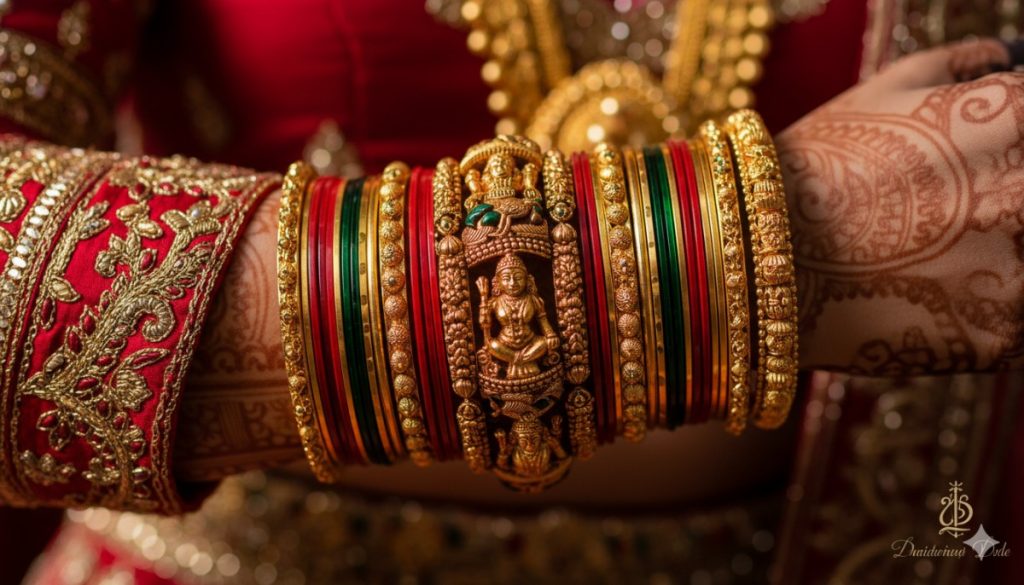
- Start: Wear one heavy Antique Screw Kangan first (closest to the elbow).
- Middle: Fill the space with 6-8 plain gold bangles or colored glass bangles (matching your saree).
- End: Finish with another heavy Antique Kangan (closest to the wrist). This frames your glass bangles and keeps the heavy pieces secure.
The “Statement” Solo
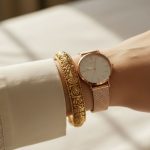
For reception or post-wedding dinners. Wear just ONE broad Antique Kada on one hand, and a watch on the other. It looks incredibly sophisticated and modern.
The Purity Debate: 22k vs 18k
For Antique Temple Jewelry, 22k Gold is the only way to go.
- Why? You need the softness of 22k gold to achieve the intricate Nakshi carving. 18k gold is too hard; it won’t allow the artisan to create those delicate eyes and fingers of the Goddess figures.
- Resale: 22k antique jewelry holds immense value as an heirloom.
Maintenance: Keeping the “Old” Look
Here is the irony: You don’t want these bangles to look shiny. The dull, blackish finish is the whole point!
- Avoid Polishing: Never give your antique bangles to a local jeweler for “cleaning” unless you specify “Do Not Polish.” If they put it on a buffing machine, they will scrub off the black antique finish, and your expensive temple bangle will look like generic shiny gold.
- Water & Soap: It is safe to wash them with mild soap to remove dirt from the crevices, but dry them immediately to prevent water spots.
Conclusion: A Sculpture You Can Wear
Buying Antique Gold Kangans is different from buying a chain or a ring. You aren’t just buying metal; you are buying a piece of art that tells a story of devotion, nature, and culture.
When you wear a Nakshi Kangan, you carry the craftsmanship of an artisan who spent weeks hammering that single piece. It is heavy, yes. It is expensive, yes. But when you look down at your hands during the wedding rituals, the glow of that antique gold against your henna designs? It is absolutely priceless.
I’d love to know: Which motif speaks to you more—the wealth of Goddess Lakshmi or the grace of the Peacock? Let me know in the comments below!
Frequently Asked Questions (FAQs)
Why is antique gold jewelry more expensive than plain gold?
It comes down to “Making Charges” (Majdoori). Plain gold bangles are often machine-made. Antique Temple jewelry is Handmade. An artisan spends days carving the intricate figures. Therefore, the making charges for antique jewelry range from 20% to 35%, whereas plain gold is around 10-14%.
Can I resize a screw Kangan?
No. Antique bangles with Nakshi carving cannot be resized. Cutting and soldering them would destroy the continuous pattern of the design (e.g., cutting a peacock in half). Always buy the correct size. The screw mechanism gives you some flexibility for putting it on, but the diameter is fixed.
What is “Nakshi” work?
Nakshi is the art of “carving” or “sculpting” gold sheets into 3D forms. Unlike casting (where molten gold is poured into a mold), Nakshi involves hammering the gold from the back (repoussé) and carving from the front to create deep, detailed relief work.
Is antique gold duller than yellow gold?
Yes, intentionally. It has a matte, oxidized finish. However, the gold underneath is still high-purity 22k. The dullness creates contrast, allowing the design details to be seen clearly.