The air is filled with the scent of marigolds, the markets are buzzing with eager shoppers, and the calendars are marked for the most auspicious day of the Indian financial year: Dhanteras.
For centuries, the tradition has been clear—buy metal to invite Goddess Laxmi into your home. While utensils were the norm in ancient times, today, the gold standard (quite literally) is Gold.
But as you stand at the jewelry counter with your budget in hand—whether it is ₹10,000 or ₹1,00,000—you face the classic dilemma. Should you buy a “Shagun” Gold Coin (pure investment) or a piece of Small Jewellery (wearable art)?
It’s a battle between the Head (Investment/ROI) and the Heart (Fashion/Emotion). In this comprehensive guide, we will break down the math, the making charges, and the long-term value to help you decide what is best for your portfolio—and your jewelry box—this Diwali 2025.
Read more: Matte Finish Gold Jewellery
The Contender 1: “Shagun” Gold Coins (The Purist’s Choice)
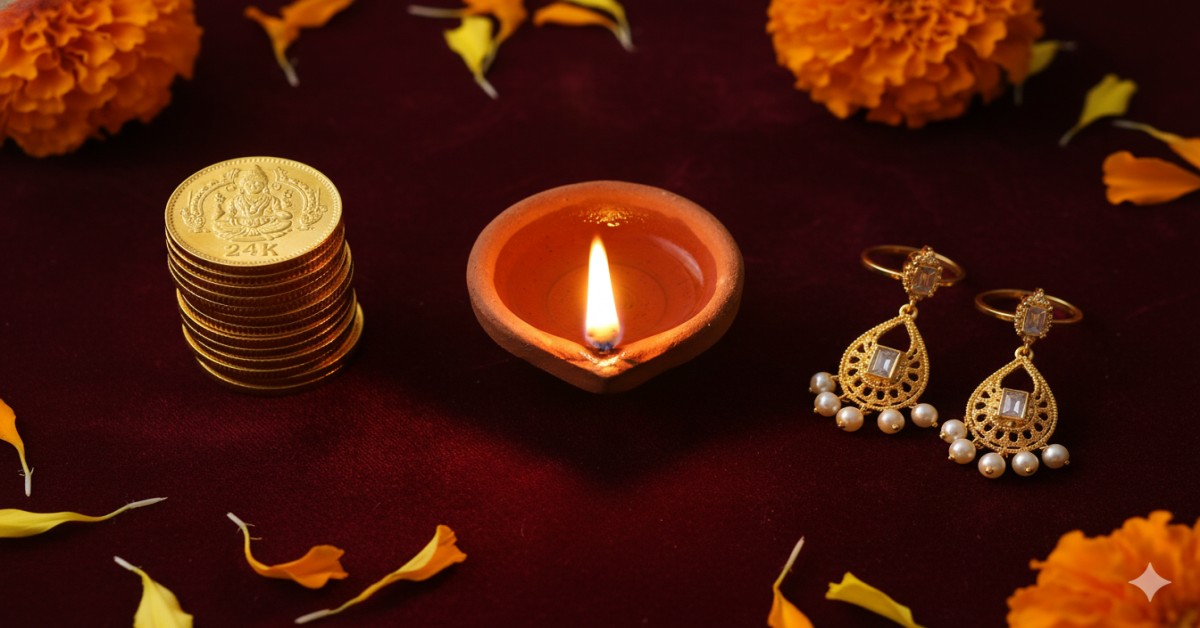
When we talk about “Shagun,” we are talking about auspiciousness. Gold coins are often seen as the purest form of welcoming wealth because they are typically bought in 24K purity (99.9%), unlike jewelry which is usually 22K or 18K.
1. The Making Charge Advantage
This is the biggest financial argument for coins. When you buy jewelry, you pay for the artisan’s labor (design, cutting, polishing). When you buy a coin, the design is standard.
- Jewellery Making Charges: Can range from 15% to 30% depending on the design.
- Coin Making Charges: Typically range from 2% to 5%.
The Math: If you buy ₹50,000 worth of gold, buying a coin means you get ~₹48,000 worth of actual gold. Buying jewelry might mean you only get ~₹40,000 worth of gold, with the rest gone in labor costs that you won’t get back when you sell.
2. Purity Guarantee
Coins and bars are usually minted in 24 Karat (999 purity). This is gold in its softest, purest form. It is liquid cash. You can sell it anywhere in the world, and the purity is rarely questioned if it is in tamper-proof packaging from a reputed refinery (like MMTC-PAMP).
3. The “Future Jewellery” Logic
Many smart Indian families buy coins every Dhanteras not to keep them as coins forever, but to accumulate weight.
- Strategy: Buy a 5g or 10g coin every Diwali for 5 years.
- Result: In 5 years, you have 50g of pure gold. You can then melt this (or exchange it) to make a heavy wedding necklace. It acts as a forced savings plan.
The Contender 2: Small Jewellery (The Wearable Asset)
On the other side, we have the allure of vanity. Why lock your investment in a dark locker when you can wear it? Small, lightweight jewelry—earrings, pendants, rings—is trending heavily for Dhanteras 2025.
1. The “Double Utility” Factor
A gold coin sits in a locker. A pair of gold earrings sits on your ears, enhancing your beauty and social status.
- Utility: You get to enjoy your asset.
- Emotional Value: Jewellery often carries memories—”I bought this ring on my first promotion” or “This pendant was from my first Diwali after marriage.” A coin rarely carries that emotional weight.
2. The 18K and 22K Shift
Modern “daily wear” jewelry is often made in 18K gold (75% gold, 25% other metals) or 22K gold (91.6% gold).
- Durability: 18K and 22K are harder and more durable than 24K coins, making them suitable for daily use.
- Style: Rose gold and diamond-studded pieces are usually 18K. If you want something trendy, jewelry is the only path.
3. Stree Dhan (Women’s Wealth)
In the Indian context, jewelry is traditionally considered Stree Dhan—property that belongs exclusively to the woman. While a gold coin might be considered a “family asset” or “household investment,” a necklace or bangle is often viewed as the personal property of the woman who wears it. For many, this ownership distinction is crucial.
The Comparison: Head-to-Head
Let’s look at the numbers. Assume the Gold Rate is roughly ₹7,500 per gram (illustrative).
| Feature | Gold Coin (24K) | Small Jewellery (22K) |
| Purity | 99.9% (Purest) | 91.6% (Standard) |
| Making Charges | Low (2% – 5%) | High (12% – 25%) |
| Resale Value | Excellent (Get near market rate) | Lower (Making charges are lost) |
| Wearability | Zero (Locker only) | High (Daily/Occasional) |
| Liquidity | Very High (Easy to sell) | High (But deduction applies) |
| Purpose | Investment & Future Exchange | Fashion & Usage |
The Verdict: Who Should Buy What?
So, what should you do this Dhanteras? It depends on your goal.
Scenario A: The “Investor”
You should buy a Gold Coin if:
- You are buying strictly for investment purposes.
- You want to accumulate gold for a future wedding (yours or your child’s).
- You have a smaller budget (e.g., 1g or 2g) and don’t want to waste money on the high making charges of tiny jewelry pieces.
- You want 24K purity.
Scenario B: The “Fashionista”
You should buy Small Jewellery if:
- You believe that “gold bought should be gold worn.”
- You need a gift for your wife, sister, or mother (gifts are better when they can be used!).
- You are buying for the long term and don’t plan to sell it soon, so the loss on making charges doesn’t bother you as much as the joy of wearing it.
- You are looking for a tax-saving or business expense (corporate gifting of coins is common, but personal gifting of jewelry has different social value).
A Third Option? The Rise of Digital Gold
For the tech-savvy generation, there is a third contender: Digital Gold or Gold ETFs/SGBs.
- Pros: No making charges, no storage risk, buy for as low as ₹1.
- Cons: You don’t get the physical “feel” of Goddess Laxmi entering your home on Dhanteras.
- Verdict: Great for investment, but it lacks the festive Shagun feel. If you are religious about the ritual, physical metal is a must.
Smart Shopping Tips for Dhanteras 2025
- Check Hallmarking: Whether coin or jewelry, ensure it has the BIS Hallmark. For 22K, look for “916”. For 24K, look for “999”.
- Buy Back Policy: Ask the jeweler, “If I come back to sell this to you next year, what will you pay?” A good jeweler will offer 100% of the gold weight value (at current rates) for coins.
- Packaging: For coins, do not tear the tamper-proof plastic card packaging. Opening it can reduce the resale value as the purity cannot be instantly guaranteed without melting/testing.
- Avoid Stone-Studded Jewellery for Investment: If you buy gold with semi-precious stones, remember: you pay for the stone weight at the price of gold, but when you sell, the stones are deducted, and you get nothing for them.
Conclusion
Dhanteras is about prosperity. Prosperity comes in many forms—a robust investment portfolio (Coins) or a confident, glowing appearance (Jewellery).
If you are practical and looking at the ROI graph, Gold Coins are the undisputed winner. They are the most efficient way to store wealth.
However, if you are sentimental and believe that wealth should be displayed and enjoyed, Small Jewellery is the winner.
The best approach? The 80/20 Rule.
Spend 80% of your budget on Gold Coins (for the locker/future) and 20% on a small, lightweight piece of jewelry (for the festival/happiness). This way, you satisfy both Goddess Laxmi (wealth) and your inner desire for beauty.
Happy Dhanteras and Happy Shopping!
Frequently Asked Questions (FAQs)
Can I convert my gold coin into jewellery later?
Yes, absolutely. This is a very common practice. You can take your 24K coin to a jeweler. They will melt it, add the necessary alloys (copper/silver) to make it 22K (durable enough for jewelry), and craft your design. You will only have to pay the making charges at that time.
Is it better to buy a 5g coin or five 1g coins?
Mathematically, a single 5g coin is better. The making/minting charges on smaller denominations (like 1g or 0.5g) are proportionally higher. You get more gold for your money with larger bars/coins.
Do banks sell gold coins? Should I buy from them?
Yes, many banks sell 24K gold coins. However, banks do not buy back gold coins. If you want to sell it later, you will have to go to a jeweler, who might cut the packet to test purity. Buying from a reputed jeweler is often better because they offer a buy-back guarantee.
What is the purity difference between 995 and 999?
999 is 99.9% pure gold (the highest standard). 995 is 99.5% pure gold. While the difference is microscopic, 999 usually commands a slightly higher premium. For investment, always aim for 999.
Are silver coins a good alternative if my budget is low?
Yes! If gold is out of budget, Silver is considered equally auspicious for Dhanteras. You can buy 999 purity silver coins with Laxmi-Ganesh embossing. Silver is also an industrial metal and has seen great appreciation in value recently.