In the vast, glittering world of Indian jewellery, plain gold has always been the standard for investment and tradition. But for the modern fashionista and the contemporary bride, standard gold can sometimes feel… safe. Predictable. Monotone.
Enter Multicolor Meenakari Gold Sets.
Often described as the “Holi” of the jewellery world, these pieces are a celebration of vibrant hues fused with the timeless elegance of yellow gold. Just as the festival of Holi splashes color onto a blank canvas, Meenakari breathes life, personality, and vivid storytelling into metal.
From the royal courts of Rajasthan to the modern wedding reception in Mumbai, let’s dive deep into why Multicolor Meenakari is the hottest trend of 2025 and how you can style these masterpieces.
The Canvas of Gold: What is Meenakari?
Before we discuss trends, we must appreciate the art. Meenakari is the art of coloring and ornamenting the surface of metals by fusing brilliant colors over it. The word comes from Meena, which is the Persian word for heaven (referring to the azure color of the sky).
While the art form originated in Persia, it was brought to India by the Mughals and found its true soul in Rajasthan, specifically Jaipur and Varanasi.
Unlike other forms of jewellery where the focus is solely on the gemstone or the gold weight, Meenakari is about enameling. Artisans etch intricate depressions into the gold surface and fill them with colored enamel dust. These are then fired in a kiln, fusing the color to the metal. The result? A piece of jewellery that is heat-resistant, scratch-resistant, and visually spectacular.
Read more: Kundal Work Gold Bangles
Why Multicolor Meenakari is the “Holi” of Jewellery
Why do we compare this art form to Holi? Because it represents the breaking of monotony.
1. A Symphony of Colors
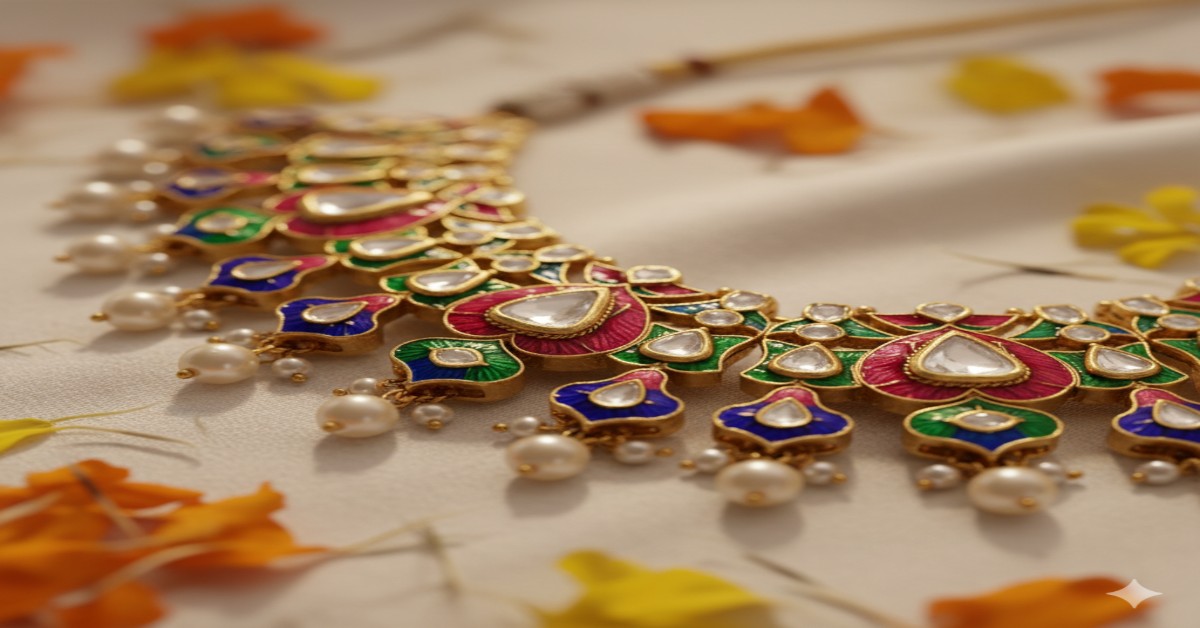
Traditional South Indian jewellery focuses on the yellow gleam of gold. Temple jewellery focuses on solidity. But Meenakari focuses on joy. A single necklace can feature:
- Firoza (Turquoise Blue): Reminiscent of the sky.
- Gulabi (Pink): The signature of Jaipur (The Pink City).
- Hara (Green): Representing nature and fertility.
- Laal (Red): The color of passion and matrimony.
When these colors come together in a single “Panchrangi” (five-colored) set, the jewellery looks like a frozen splash of festival colors.
2. Versatility Like No Other
A plain gold necklace might clash with a silver-embroidered lehenga. A diamond set might look too subtle for a heavy Kanjeevaram saree. However, a Multicolor Meenakari Gold Set is the ultimate chameleon. Because it contains red, green, blue, and white, it matches everything. Whether you are wearing a pastel pink Anarkali or a deep maroon saree, the multicolor elements pick up the hues of your outfit and amplify them.
Trending Multicolor Meenakari Designs for 2025
If you are looking to invest in a set this year, here are the top designs dominating the market.
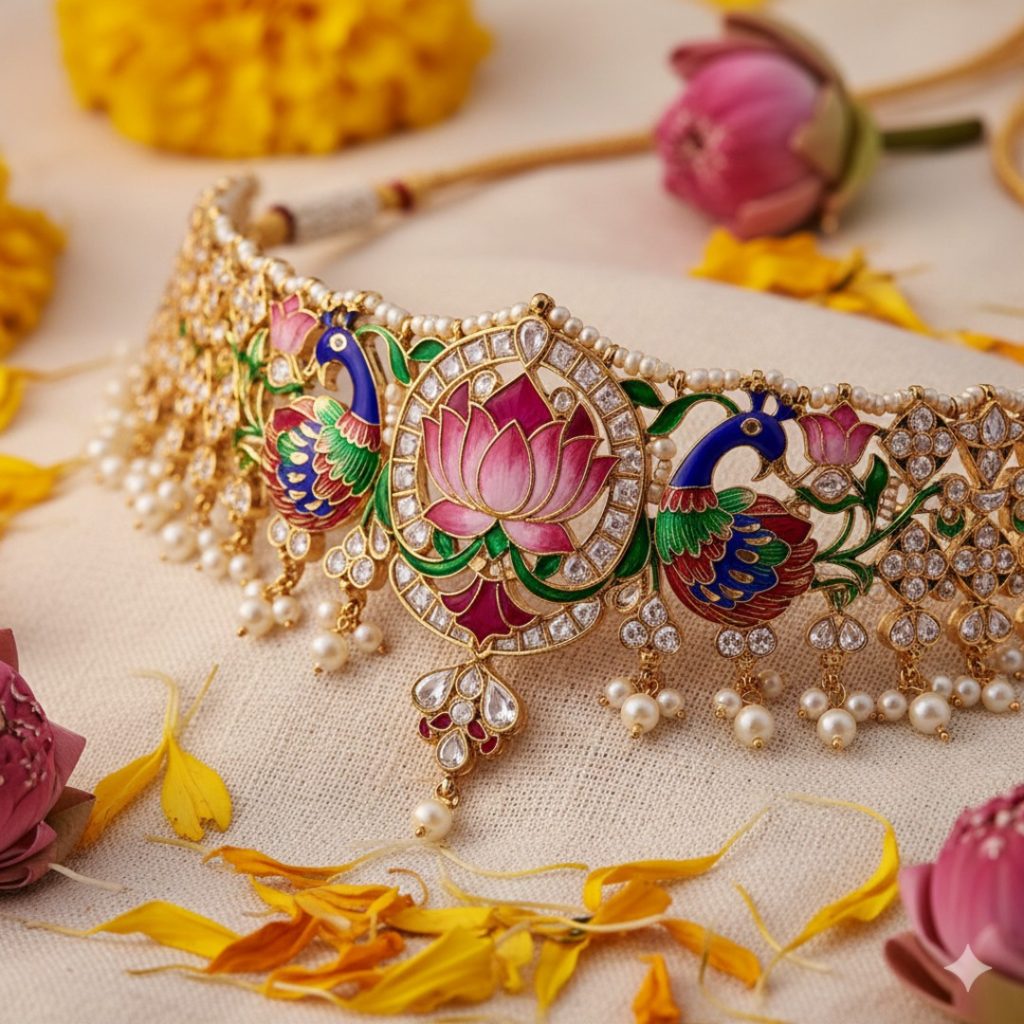
The “Gulabi” Lotus Choker
The lotus motif is sacred in Indian art. In 2025, we are seeing a massive surge in chokers that feature pink (Gulabi) enamel lotus flowers against a white or green enamel background. These pieces are often accented with small pearls (Moti) and Kundan stones. They are soft, feminine, and perfect for day weddings.
The Peacock Symphony (Mor-Mogras)
The peacock is the national bird of India and a symbol of grace. Multicolor sets often use the peacock motif to introduce vibrant blues and greens. A heavy “Rani Haar” featuring dual peacocks with their feathers spread out in Meenakari work is a statement piece that requires no other accessory.
Pastel Meenakari: The Modern Twist
While traditional Meenakari uses deep, dark primary colors, the “Holi” trend has evolved. Modern brides are opting for Pastel Meenakari. Think mint greens, powder blues, and blush pinks enameled onto gold. These sets are specifically designed to match the trending pastel bridal lehengas popularized by celebrity weddings.
Reversible Meenakari (The Two-in-One)
This is the smartest investment you can make. Many high-end Polki sets feature uncut diamonds on the front and intricate Multicolor Meenakari on the back. It is designed to be comfortable against the skin, but savvy fashionistas often flip the necklace to wear the Meenakari side forward for a completely different, colorful look.
Styling Guide: How to Wear the “Holi” Look
Wearing multicolor jewellery can be tricky. You don’t want to look like a costume drama. Here is how to style it like a pro.
1. The Contrast Rule (For Weddings)
If your outfit is a single solid color, let your jewellery bring the Holi vibe.
- The Look: A solid Emerald Green silk saree.
- The Jewellery: A Multicolor Meenakari set featuring heavy reds, pinks, and pearls.
- Why it works: The jewellery pops against the solid dark background, becoming the hero of the look.
2. The Harmony Rule (For Day Events)
If you are wearing a floral print or a multicolor outfit, match the dominant color of the Meenakari to the secondary color of your dress.
- The Look: A floral lehenga with pink and yellow flowers on a white base.
- The Jewellery: A Meenakari set where Pink is the primary enamel color.
- Why it works: It ties the busy pattern of the dress together without creating chaos.
3. The Fusion Boss Lady (For Corporate/Parties)
Who says Meenakari is only for weddings?
- The Look: A crisp white button-down shirt tucked into a high-waisted beige skirt.
- The Jewellery: A sleek, stiff Meenakari collar necklace (Hasli) in multicolor geometric patterns.
- Why it works: It adds a touch of Indian heritage to a western silhouette. It shows confidence and distinct style.
Buying Guide: Real vs. Imitation
Since you are reading GoldStyleHub, we prioritize value. However, Meenakari is available in various ranges.
22K Gold Meenakari (The Investment)
This is the real deal. The base is 22K gold. The value lies in the gold weight and the intricacy of the art.
- Pros: High resale value, heirloom quality.
- Cons: Expensive; enamel work generally has no buy-back value (you only get paid for the gold weight).
Silver-Based Gold Plated (The Smart Budget Choice)
Many designers now craft high-quality Meenakari on silver and plate it with 22K gold.
- Pros: Looks identical to real gold, costs a fraction of the price (₹15,000 – ₹50,000).
- Cons: Needs care to prevent plating from fading.
Imitation/Brass (The Fast Fashion)
- Pros: Very cheap (Under ₹5,000).
- Cons: The “Meenakari” is often just paint, not fired enamel. It lacks the depth and shine of the real art and can look tacky if inspected closely.
Care and Maintenance
Meenakari is durable, but it is effectively glass fused to metal. It needs respect.
- No Perfume: Alcohol can dull the shine of the enamel over time. Always spray your perfume before putting on your jewellery.
- Separate Storage: Do not throw your Meenakari set into a box with other gold chains. The enamel can chip if scratched by sharp metal edges. Wrap each piece in soft cotton or a velvet pouch.
- Heat Protection: While fired at high temps, sudden extreme heat changes can cause the enamel to crack. Store in a cool, dry place.
Conclusion
In a world of minimalist trends and beige aesthetics, Multicolor Meenakari stands out as a rebellion of joy. It captures the spirit of Indian festivity—the chaos, the color, and the celebration—and immortalizes it in gold.
Whether you are a bride wanting to look regal or a guest wanting to look stylish, a Multicolor Meenakari set is more than just an accessory; it is a mood. It is the “Holi” of jewellery—vibrant, unapologetic, and spectacularly beautiful.
Frequently Asked Questions (FAQs)
Does Meenakari reduce the resale value of gold?
When you sell gold jewellery, you are paid for the weight of the gold. The weight of the enamel (Meena) and stones is deducted. Since Meenakari sets often have significant enamel work, the resale value percentage relative to the purchase price might be slightly lower than plain gold, but the artistic value remains high for heirloom purposes.
Can I wear Multicolor Meenakari with a Western Gown?
Absolutely. A heavy multicolor choker looks stunning with an off-shoulder solid black or royal blue evening gown. It creates a bold, avant-garde statement.
Is Meenakari heavy to wear?
It depends on the base. Traditional Kundan-Meenakari can be heavy due to the lac (wax) filling used in Kundan. However, modern “open setting” Meenakari on 18K or 22K gold is surprisingly lightweight and wearable for long hours.
Which color of Meenakari is most expensive?
The cost is usually determined by the intricacy of the design and the gold weight, not the color. However, Gulabi Meenakari (Pink Enamel) from Varanasi is considered one of the most skilled and labor-intensive forms, often commanding a premium for the craftsmanship.
How can I tell if the Meenakari is real or just paint?
Real Meenakari has a smooth, glossy, glass-like finish that feels cool to the touch and is fused into the metal. Painted imitation jewellery often looks flat, plastic-like, and may show brush strokes or uneven edges where the paint sits on top of the metal.