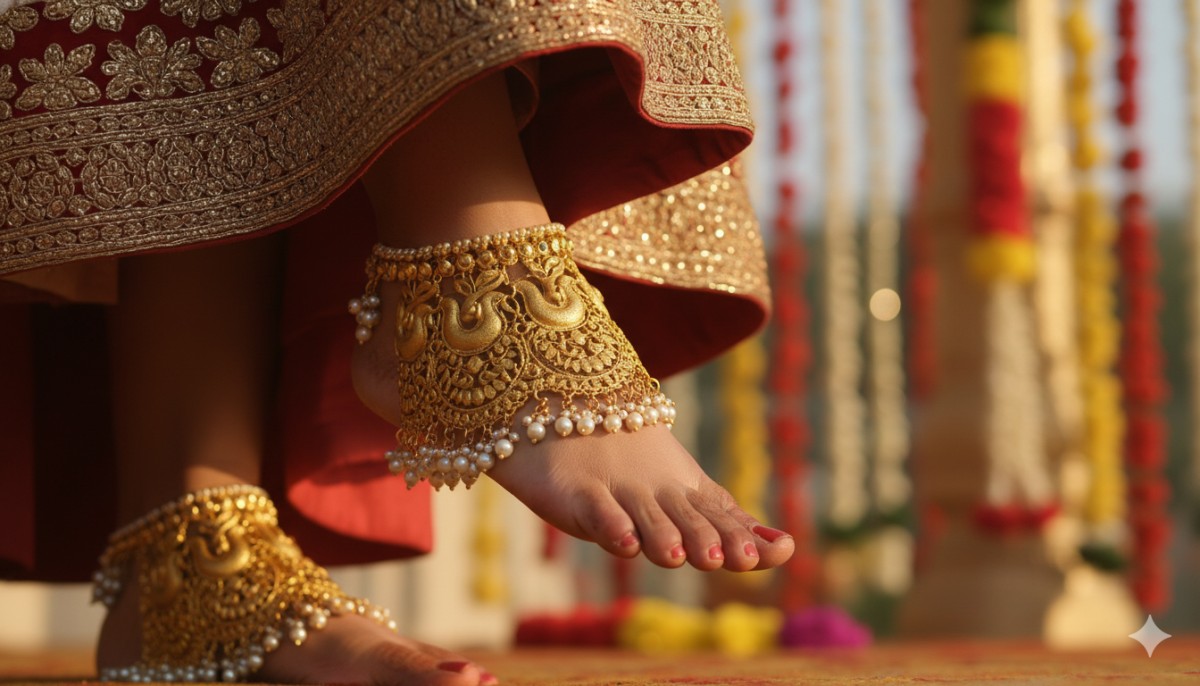
On one hand, we absolutely adore the look. A golden chain resting against the ankle looks incredibly regal, warm, and sophisticated—especially when paired with a bridal lehenga or a silk saree.
On the other hand, there are hurdles.
- The Price: With gold prices touching the sky (crossing ₹75,000 for 10 grams), buying a solid gold anklet that weighs 20-30 grams is a massive investment.
- The Superstition: In many Indian cultures, wearing gold on the feet is considered disrespectful to Goddess Lakshmi.
- The Fear: Anklets take the most beating. They drag on the floor, get splashed by mud, and rub against footwear. Losing a ₹2 Lakh gold anklet on a busy street is a nightmare scenario.
This category is currently the fastest-growing segment in the Indian jewelry market. It is the perfect middle ground: it has the value and durability of precious metal (Silver 925), but the shine and finish of 22k Gold.
In this guide, I’m going to break down why you should switch to gold-plated silver, how to distinguish quality plating from cheap polish, and how to style them for 2025.
Read more: Half Heart Split Designs
What Exactly Are “Gold Plated Silver” Anklets?
Many people confuse this with “artificial” or “imitation” jewelry. Let me clear the air.
- Imitation Jewelry: Made of brass, copper, or alloy. It has zero resale value and often causes skin allergies (itching/rashes) because of nickel.
- Gold Plated Silver: The base metal is Solid 925 Sterling Silver (a precious metal). It is Hallmarked. On top of this silver base, a layer of real 18k or 22k gold is electrically deposited.
The Result? You get a piece of jewelry that is hypoallergenic (safe for skin), has inherent value (silver price), and looks exactly like real gold to the naked eye. And the best part? It costs a fraction of the price.
Why Silver is Actually Better for Anklets than Gold
Even if money wasn’t an issue, as an editor, I often recommend silver for anklets over pure gold. Here is the technical reason why.
1. Durability Factor
Pure gold (22k) is soft. Anklets endure a lot of friction—rubbing against your heels, getting caught in saree pleats, or hitting table legs. A 22k gold anklet bends and snaps easily under this pressure.Sterling Silver (925) is structurally harder and more durable than 22k gold. It can withstand the daily “wear and tear” of foot movement much better.
2. The “Tone” Match
Cheap artificial anklets often have a “fake yellow” or “copper-orange” color that screams imitation. However, because silver is a white, bright metal, when it is plated with gold, it reflects light beautifully. High-quality “Gold Dipped” silver anklets have that buttery, matte-yellow finish that mimics antique heritage gold perfectly.
[Link to related post: 925 Silver vs. Sterling Silver: What is the Difference?]
The Technical Stuff: Micron Plating vs. Flash Plating
This is the most important section of this article. If you buy the wrong type, the gold color will vanish in two weeks. You need to know the difference.
Flash Plating (Avoid)
This is a super thin layer (less than 0.175 microns) of gold sprayed onto the silver. It is cheap, but it wears off very quickly, especially on anklets which are exposed to sweat and friction.
Micron Plating (The Gold Standard)
This is what you should look for. “Micron Plating” or “Vermeil” (pronounced Ver-may) means a thick layer of gold (usually 1 micron to 3 microns) is bonded to the silver.
- 1 Micron: Good for earrings.
- 2.5 to 3 Microns: Mandatory for Anklets. Since anklets face high friction, you need a thicker layer of gold to ensure the yellow color lasts for years.
Pro Tip: Ask for “E-Coating”. When buying gold-plated silver, ask the jeweler if it has an “Anti-Tarnish E-Coat.” This is an invisible, biological lacquer layer applied over the gold plating. It acts as a shield against sweat, perfume, and water, doubling the life of the gold color.
Trending Designs: From Bridal to Boardroom
Gold-plated silver allows for incredible versatility. Here are the top styles trending right now.
1. The “Kundan” Payal (For Brides)
These are heavy, thick anklets studded with uncut diamonds (glass polki) and pearls.
- Real Gold Cost: ₹3 Lakhs+.
- Gold Plated Silver Cost: ₹15,000 – ₹25,000.
- The Look: Indistinguishable from real jadau jewelry. Perfect for the wedding day.
2. The “Evil Eye” Chain (Daily Wear)
A thin, delicate gold chain with a small blue eye charm or a black bead.
- The Vibe: Modern, protective, and chic.
- Best For: Wearing with cropped jeans or midi dresses.
3. The “Temple” Coin Anklet
Inspired by South Indian jewelry, these feature small coins (Kasus) with Goddess Lakshmi motifs hanging from the chain.
- The Vibe: Traditional and auspicious.
- Best For: Festivals like Diwali or Varalakshmi Vratam.
Maintenance: How to Keep the Gold on the Silver
Let’s be honest—gold plating is not permanent. It will fade eventually to reveal the silver underneath. However, with the right care, you can make it last 2-3 years before needing a re-polish.
- The “Last On, First Off” Rule: Put your anklets on after you have applied body lotion and perfume. Chemicals eat gold plating.
- No Showers: Chlorine in swimming pools and salt in ocean water are the enemies of plating. Never bathe with them.
- Storage: Store them in a Ziploc bag or a plastic pouch. Do not use velvet boxes (chemicals in glue can tarnish silver) or cotton (it traps moisture). Air-tight plastic is best.
The Price Breakdown: What Should You Pay?
Don’t get ripped off. Here is the current market estimation for 925 Hallmarked Gold Plated Anklets:
- Simple Chain (5-10 grams): ₹2,000 – ₹4,000.
- Medium Designer Payal (15-25 grams): ₹5,000 – ₹8,000.
- Heavy Bridal Payal with Stones (50g+): ₹12,000 – ₹20,000.
Compare this to real gold: A 20-gram gold anklet would cost you approx ₹1.5 Lakhs. The savings are undeniable.
[Link to related post: 5 Best Silver Jewelry Markets in India for Wholesale Prices]
Conclusion: Smart Luxury
The modern Indian woman is financially savvy. She knows that tying up lakhs of rupees in a foot ornament that gets dragged through dust isn’t always the smartest investment.
Gold Plated Silver Anklets offer the best of both worlds. You respect the tradition of silver (cooling for the body), you enjoy the aesthetic of gold (rich and warm), and you keep your bank balance happy.
So, next time you are shopping for a wedding or a festival, skip the gold counter and head to the silver section. Pick up a heavy, gold-dipped silver Payal. Trust me, no one will know the difference—except you and your wallet.
I’d love to know: Are you Team “Silver Only” for feet, or do you love the “Gold Look” anklets? Tell me in the comments below!
Frequently Asked Questions (FAQs)
Will the gold color fade from the silver anklet?
Yes, eventually. Unlike solid gold, plating is a layer. Depending on the thickness (microns) and how often you wear it, the gold color will start to fade after 1-2 years, revealing the silver underneath.
Good News: You can take it to any local jeweler and get it “re-plated” or “gold dipped” for a few hundred rupees to make it look brand new.
Can I wear gold-plated silver anklets daily?
You can, but the lifespan of the plating will reduce. Anklets face a lot of friction from footwear and clothes. For daily wear, a simple plain silver anklet is best. Save the gold-plated ones for office wear, parties, or occasions to keep them shiny longer.
How do I know it is real silver inside?
Always look for the “925” Stamp or Hallmark on the clasp or the back of the anklet. This certifies that the base metal is 92.5% pure Sterling Silver. If there is no stamp, it is likely cheap brass or copper.
Is it bad luck to wear gold-colored anklets?
This depends on your personal and family beliefs. Traditionally, gold is Goddess Lakshmi and isn’t worn on the feet. However, many modern women argue that since the base metal is silver (which is acceptable for feet), the gold plating is just a color/aesthetic choice and not disrespectful.