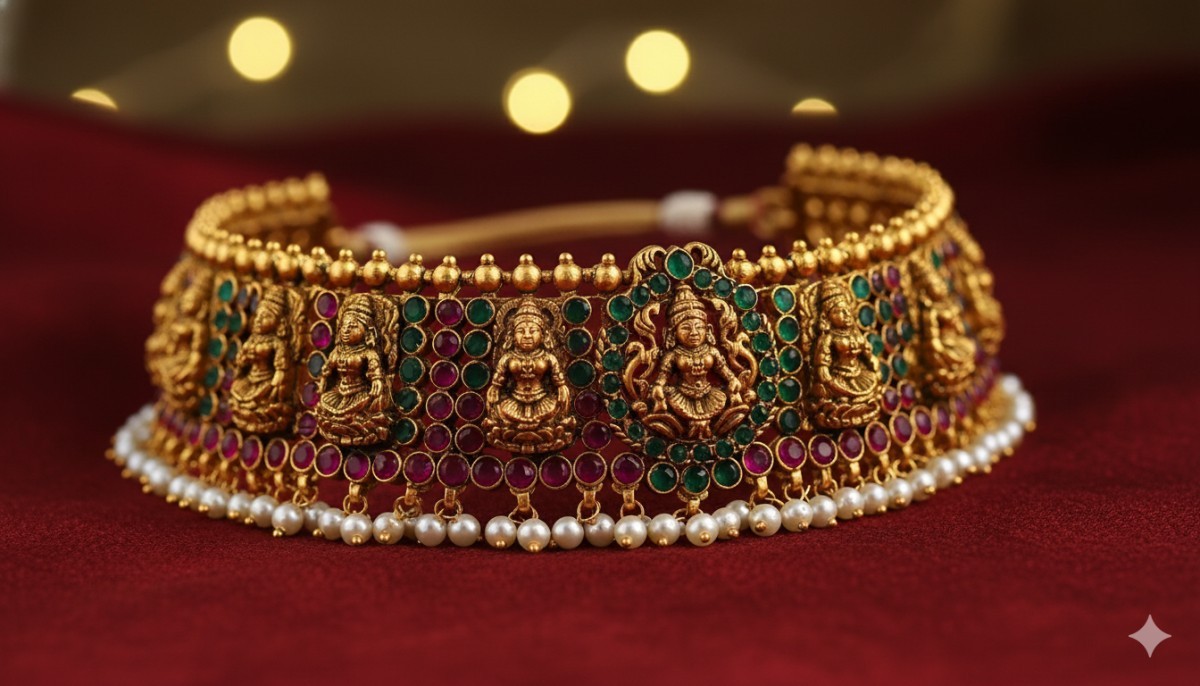
We have all been there. You are rummaging through your grandmother’s heavy iron locker or old velvet boxes, looking for something unique to wear for a cousin’s wedding. You push aside the heavy Harams and the long chains, and then you find it.
A small, delicate, close-fitting necklace studded with deep pinkish-red stones. It looks unassuming, but the moment you put it on, it transforms your entire look.
This is the legendary Attigai Necklace.
For decades, the Attigai was the “daily wear” luxury for women in Tamil Nadu and Karnataka. But today? It has exploded onto the fashion scene. From classical dancers to modern brides in Sabyasachi sarees, everyone wants an Attigai.
As a jewelry editor, I call this the “Quiet Luxury” of South India. It doesn’t scream for attention like a diamond necklace; it commands it with elegance. In this guide, I will explain what makes the Attigai special, how to tell if it’s real, and how to style this vintage beauty in 2025.
Read more: “Rani Haar” Designs
What Exactly is an Attigai?
The word Attigai roughly translates to “close-fitting” or “clinging” in Tamil. Unlike a loose chain, an Attigai is designed to sit right at the pit of your throat, resting on the collarbone. It is the original choker.
The Signature Look:
- The Shape: It is usually a series of square, round, or floral pieces linked together flexibly.
- The Stones: It is almost always studded with Kemp stones (rubies or spinels) and sometimes uncut diamonds. The deep, matte red color is its trademark.
- The Pendant: Often, it features a central pendant (Padakkam) with a motif of a swan (Annam) or Goddess Lakshmi, dangling slightly lower than the rest.
Why It Is Making a Huge Comeback
Fashion is cyclical. After years of heavy, oversized bridal jewelry, the modern Indian woman craves something lightweight yet traditional.
- It’s Neck-Friendly: Unlike stiff metal chokers that poke and pinch, an Attigai is usually made of small, linked units. It moves with your neck.
- The “Kemp” Aesthetic: The unique reddish-pink color of Kemp stones complements the Indian skin tone perfectly. It glows against a Kanjeevaram saree.
- Versatility: You can wear it to a small puja at home or layer it for a massive wedding. It never looks out of place.
Technical Guide: Real Gold vs. “Temple” Imitation
This is where many buyers get confused. Because Attigai designs are so popular in Bharatanatyam dance jewelry (which is often gold-plated copper), people assume they are cheap. But a real Gold Attigai is a serious investment.
1. The Gold Purity
A traditional heirloom Attigai is made in 22k Gold. The gold serves as a casing for the stones. Because the stones take up a lot of surface area, the gold weight is surprisingly light.
- Weight Range: You can get a stunning Attigai in just 15 to 25 grams of gold.
2. The “Closed” Setting
Authentic Attigais use a Closed Setting (Kundala Velai). The back of the necklace is covered with gold. The stones are embedded into the metal, often using a natural lac (wax) filling to hold them in place.
- Why this matters: This technique protects the stones and gives the necklace a smooth back that doesn’t irritate the skin.
3. The Stones (Ruby vs. Synthetic)
- Burma Rubies: High-end antique pieces use real rubies. These cost lakhs.
- Spinels/Synthetic Stones: Most modern and affordable gold Attigais use synthetic stones to keep the price down. The value is in the gold and the craftsmanship, not the stone itself.
Pro Tip: Watch the Thread! A traditional Attigai doesn’t use a gold chain at the back. It uses a thick black or red adjustable thread (Dori). Why? Because the necklace needs to be tied tightly to sit high on the neck. A gold chain often slides down. If you want the authentic “Granny” look, stick to the thread!
Styling The Attigai: 3 Modern Ways
You have the necklace. Now, how do you wear it without looking like you are going to a dance recital?
1. The Minimalist Guest
Wearing a simple silk or linen saree? Wear just the Attigai. No long chains. Pair it with small Jhumkas. The Attigai fills the neckline beautifully, making you look dressed up without trying too hard.
2. The “Shirt” Hack
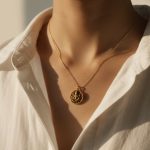
This is a trend I love. Take a crisp white button-down shirt. Open the top button. Wear the Attigai inside the collar. The pop of antique gold and red stones against the stark white shirt is absolute fusion magic. Perfect for an office party or a brunch.
3. The Bridal Layer
For brides, the Attigai is the perfect “Level 1” necklace.
- Layer 1: Attigai (Choker).
- Layer 2: Mid-length Guttapusalu or Coin Necklace.
- Layer 3: Long Haram. Because the Attigai is slim, it leaves plenty of room for the heavier necklaces below it.
[Link to related post: 5 South Indian Necklaces Every Bride Must Own]
Maintenance: Keeping the “Kemp” Bright
Attigai necklaces are prone to trapping dust because of the intricate stone settings.
- The Toothbrush Trick: Use a soft baby toothbrush to gently dust between the stones.
- No Water Soaking: If your Attigai is made with the traditional Lac (wax) filling inside, never soak it in hot water. The heat can melt the wax and loosen the stones. Just wipe it with a damp cloth.
Conclusion: A Hug from History
The Attigai Necklace is more than just a piece of jewelry. It is a hug from history. It sits close to your pulse, reminding you of the generations of women who wore it before you.
Whether you inherit one or buy a new one, you are buying a piece of art that has survived centuries of changing fashion trends. It was stylish in 1920, it is stylish in 2025, and I guarantee you, it will be stylish in 2050.
Tell me: Do you prefer the classic Full-Ruby Attigai, or the Multi-Color (Navratna) style? Let me know in the comments below!
Frequently Asked Questions (FAQs)
What is the starting price of a gold Attigai?
Since they are relatively lightweight, a gold Attigai is affordable compared to other bridal jewelry. For a piece with 15-20 grams of 22k gold (using semi-precious stones), the price typically ranges from ₹1.2 Lakh to ₹1.8 Lakh, depending on making charges.
Can I wear an Attigai if I have a short neck?
Yes! In fact, an Attigai is better than a wide bridal choker for short necks. Because the Attigai is usually thin and delicate, it doesn’t “cut off” your neck visually. Wear it slightly lower (at the collarbone) to create length
What are “Kemp” stones?
Originally, Kemp meant “Red” in Kannada/Telugu and referred to high-quality rubies. Today, in the context of temple jewelry, “Kemp stones” usually refer to synthetic rubies or spinels that have a matte, deep red finish (not sparkly/glassy).
Is the Attigai only for South Indians?
Not at all. While the design is South Indian (Tamil/Kannada roots), the aesthetic is universal. It pairs beautifully with Benarasi sarees, Lehengas, and even Western gowns.