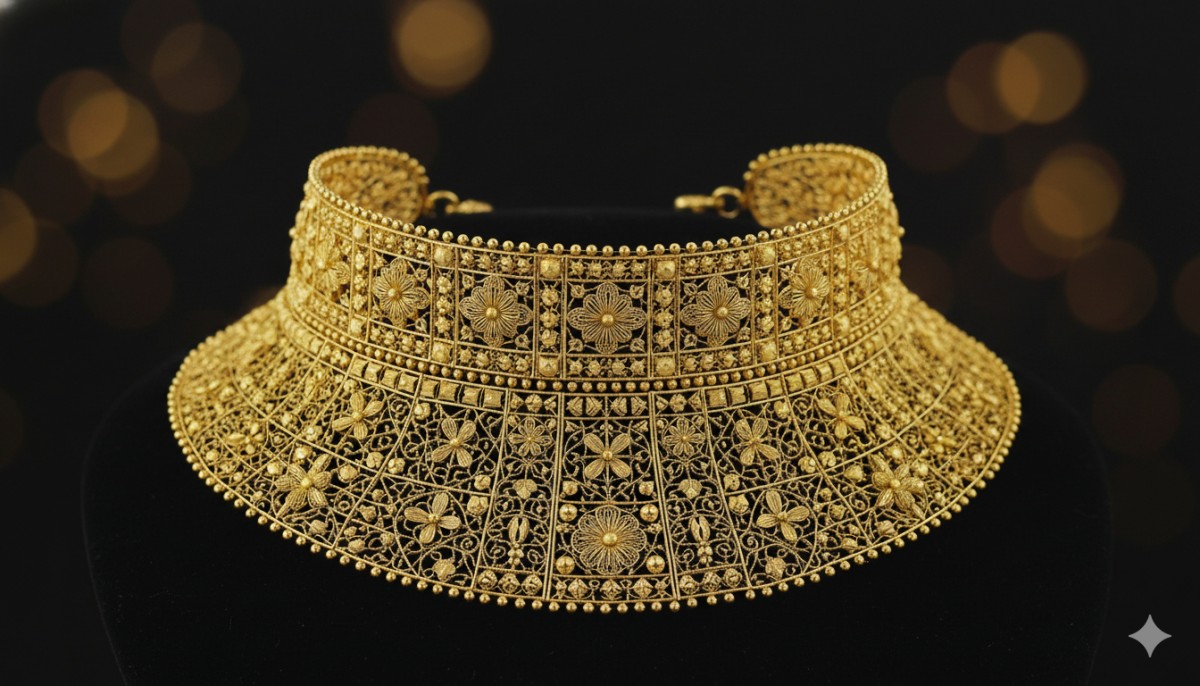
The ultimate desire in modern gold jewellery is the ability to achieve maximum visual impact without the burden of excessive weight and prohibitive cost. The ancient craft of Mesh Work (Jaali) , also known as Tarakashi (filigree) or cutwork, provides the perfect solution. By replacing solid metal with intricate patterns of fine gold wire or delicate cutouts, artisans can create spectacular, large-sized necklaces that remain surprisingly light in weight.
The Jaali Gold Set is the epitome of smart luxury, allowing the consumer to buy jewellery that looks like it weighs 80 grams but is actually closer to 30 grams. This comprehensive guide explores the specialized techniques of Mesh Work, analyzes the financial advantages of buying volume over weight, details the trending designs, and explains why this style is the essential choice for the budget-conscious consumer seeking bridal or grand festive looks.
Read more: Fancy Gold Ring Designs for Girls
1. The Art of Lightness: Understanding the Jaali Technique
The core principle of Jaali work is simple: use air and negative space as primary design elements. This technique maximizes perceived volume while minimizing actual gold consumption.
A. Filigree (Tarakashi) Work
This is the most traditional form of Jaali. It involves drawing pure gold into extremely thin wires and meticulously soldering them together to form complex, open, lace-like patterns (mesh). The result is a piece that is voluminous and translucent but uses minimal material.
B. Sheet Metal Cutwork
The modern adaptation uses advanced technology (often laser cutting) to create intricate patterns—geometric, floral, or abstract—in a thin sheet of gold. The gold is cut away to leave a delicate, supportive frame, creating the same open, airy effect as filigree, often with cleaner lines.
C. Volume Through Negative Space
The success of Jaali is that the eye perceives the total area covered by the design, rather than just the density of the metal. This visual trick allows a piece to look broad, elaborate, and heavy while remaining feather-light and comfortable.
2. The Financial Advantage: Buying Volume, Not Just Weight
For the Indian consumer, where gold purity (22K) is mandatory, Jaali work offers significant financial benefits related to both purchase price and cost-per-wear.
| Metric | Solid Gold (80g) | Mesh Work (30g) | Advantage of Mesh Work |
| Intrinsic Gold Cost | High | Low | Saves up to 60% on the core gold price. |
| Making Charges | High (per gram) | Higher (per gram, due to skill) | Overall cost is still far lower because the initial weight is drastically reduced. |
| Wearability/Comfort | Heavy (difficult for all-day wear) | Light (comfortable and easy to wear for long events) | Maximizes actual usage and comfort. |
The lower intrinsic gold cost means a beautiful, grand necklace can be purchased on a mid-range budget, making grand pieces more accessible.
3. The Engineering of the Big Necklace (Design Anatomy)
To create a Big Size Necklace (like a broad collar or Haram) that is light, specialized construction techniques are necessary:
A. Hollow Pendants
Any large central pendant in a Jaali set must be hollow. The pendant’s back is often a smooth, separate gold sheet welded to the patterned front. This maintains the grand size while ensuring the piece does not become unwearably heavy.
B. Wide Collar Construction
Jaali necklaces designed to cover a wide area (collar style) utilize rigid mesh panels linked together. The rigidity of the panel ensures the broad shape holds without being dense, perfectly framing the neck.
C. Purity and Durability
While 22K gold is traditionally used, the fine wires and thin links of Jaali work are structurally delicate. Jewelers often recommend 18K gold for the specific mechanisms (clasps, hinges) to provide the necessary hardness and structural integrity, preventing the thin gold threads from bending or breaking easily.
4. Top Mesh Work (Jaali) Design Styles
The intricate nature of Jaali work allows for incredible artistic variation, from ancient Mughal patterns to sleek, modern designs.
1. Mughal Jali Collar
- Design: A broad, structured choker featuring incredibly dense, intricate filigree wirework in geometric or floral patterns, echoing the stone lattice screens found in Mughal architecture.
- Aesthetic: Highly regal and traditionally formal, often paired with ruby or pearl accents woven into the filigree.
2. Geometric Cutwork Haram
- Design: A long necklace (Haram) composed of large, repeating, uniformly shaped gold plates (often squares, hexagons, or stylized teardrops) with laser-cut internal mesh patterns.
- Look: Modern, sleek, and highly structured, creating a striking line of volume down the chest.
3. Lace-Style Filigree Necklace
- Design: Soft, delicate filigree arranged in complex, flowing, net-like patterns. This style is often used for long necklaces, giving the piece a fine, almost fabric-like fluidity.
- Contrast: Perfect for complementing heavy silk sarees, providing a textural contrast to the fabric.
4. Meenakari-Integrated Jaali
- Design: The open meshwork is strategically accented with tiny pockets of Meenakari (enamel work) in deep colors (blue, green). The color pools into the gold cells, enhancing the visual appeal of the pattern.
- Volume: The color draws the eye to the pattern, further maximizing the perceived size and density.
5. Modern Abstract Mesh
- Design: Features fluid, non-traditional shapes with open, free-flowing gold netting. This style is often seen in rose or white gold accents, appealing to younger buyers seeking a contemporary fusion look.
5. Purity, Durability, and Maintenance
A. Fragility and Handling
Due to the hollow construction and fine wirework, Jaali jewelry is highly delicate. It must be handled with care to avoid accidental denting (of hollow pendants) or snapping (of fine wires). Avoid wearing these pieces during heavy activity.
B. Cleaning Challenges
The intricate latticework traps dust, makeup, and dirt easily. Cleaning requires dedication: use a soft brush and mild soap and water only. Ultrasonic cleaners and harsh chemicals are strictly forbidden, as they can dislodge fine wires or warp the delicate gold.
C. Secure Storage
Store Jaali necklaces flat in a separate, velvet-lined box. Never hang them, as the weight of the pendant can strain the fine filigree chain links over time.
Conclusion
Mesh Work (Jaali) Gold Sets are the triumph of smart craftsmanship, offering the perfect balance between grand presentation and financial prudence. By embracing the ancient art of filigree and modern cutwork, the buyer secures a Big Size Necklace in Light Weight, ensuring their investment is both spectacularly voluminous and delightfully comfortable for any major festive occasion.
Frequently Asked Questions (FAQs)
Does Jaali work use less gold?
Yes, significantly. Because the design replaces solid gold with open air and fine wires, a large Jaali necklace can weigh 50% to 70% less than a solid gold necklace of the same visual size, drastically reducing the intrinsic gold cost.
Is Mesh Work jewelry durable enough for occasional wear?
Yes, it is suitable for occasional wear (weddings, parties) if handled with care. The intricate structure is surprisingly strong against simple movement, but it is vulnerable to denting and crushing if accidentally dropped or squeezed.
Which gold purity is recommended for Mesh Work bangles?
22K gold is traditional for the main body. However, for bangles (which see more impact), some modern jewelers use 18K gold for the fine wires to increase hardness and reduce the risk of the delicate mesh bending or breaking.
How does the making charge for Jaali work compare to plain gold?
The making charge (labor cost) per gram is significantly higher for Jaali work due to the meticulous, time-intensive hand-soldering (Tarakashi) or precision cutting required. However, because the total weight is low, the final overall price is generally much lower than a comparable heavy piece.