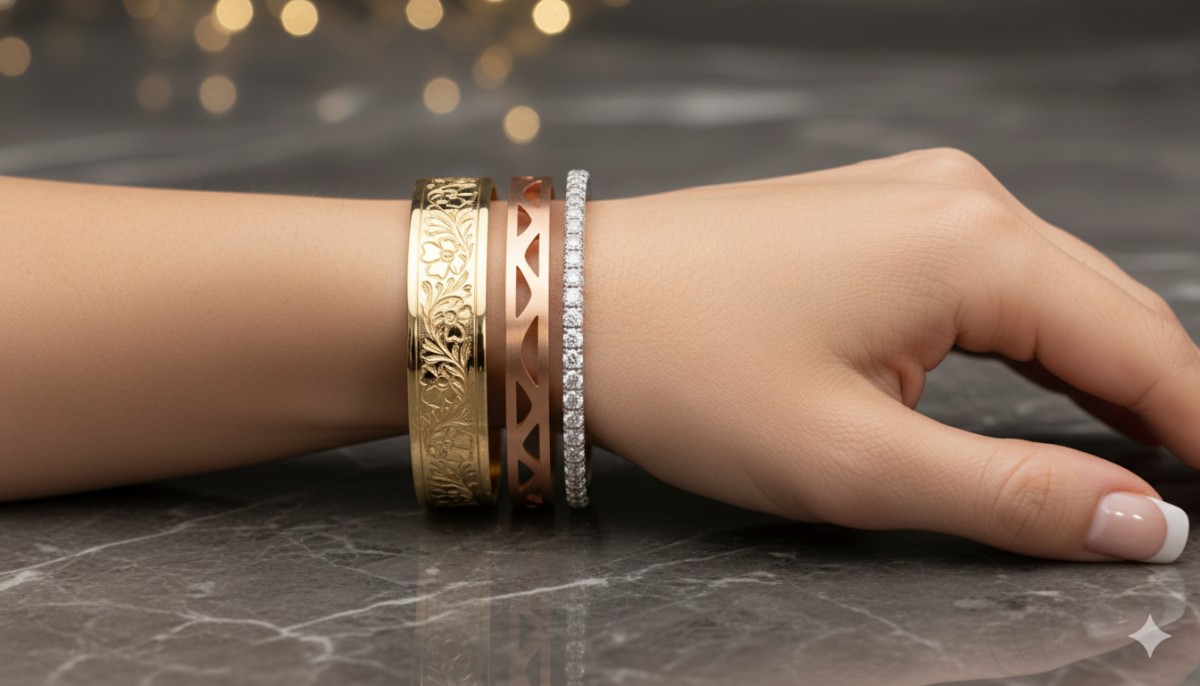
The ultimate expression of wrist wear luxury in modern jewelry is the expertly crafted stack of bangles. Moving past the uniform look of single pieces, the trend now focuses on Mixing Gold & Diamond Bangles to create a dynamic visual effect: the deep, warm structure of high-karat gold juxtaposed against the cool, perpetual brilliance of diamonds. This styling technique elevates jewelry from mere adornment to an intentional fashion statement, signifying both timeless investment and contemporary style.
Creating a successful luxury stack is an art that requires understanding proportion, balance, and the physics of light. It’s about achieving a high-impact, opulent look without appearing cluttered or noisy. This comprehensive guide breaks down the essential rules, the technical blueprint, and the best designs for flawlessly Mixing Gold & Diamond Bangles to achieve the ultimate high-end finish.
Read more: Red Coral (Moonga) Gold Bracelet
1. The Formula for Opulence: Structure Meets Sparkle
The aesthetic success of the mixed stack lies in the powerful contrast between the two materials.
A. Gold: The Anchor and Structure
Plain gold bangles (or Kadas) provide the necessary weight, structure, and foundation. They ground the stack, conveying tradition, warmth, and the stability of high investment. Yellow gold is particularly effective, offering a rich canvas for the diamonds to shine against.
B. Diamonds: Light, Texture, and Movement
Diamond bangles (like tennis or eternity bracelets) introduce light, texture, and movement. Their brilliance ensures the stack catches the light from every angle, creating the high-impact sparkle required for a luxury look.
C. The Visual Balance
The mix ensures the stack avoids two pitfalls: a stack of only diamonds can look overly glitzy, and a stack of only plain gold can look heavy and dull. The alternating contrast creates visual interest and sophistication.
2. The Golden Rules of Stacking: Mastering Proportion
A luxury stack must look balanced, not cluttered. This requires adherence to rules governing number and ratio.
A. The Odd Number Rule (3 or 5)
A stack of bangles should always feature an odd number of pieces (3, 5, or 7). The odd number creates a visual center and balance, making the entire arrangement feel more sophisticated and less random than an even stack.
B. The 2:1 Ratio (Structure to Brilliance)
A safe and highly effective ratio is 2:1 or 3:1. For every one Diamond Bangle (the statement piece), use two or three Solid Gold Bangles (the anchors). This ratio ensures the diamonds remain the focal point, while the gold provides the opulent framing required.
C. Varying the Width
To prevent the stack from looking like a single, thick metal band, mix widths:
- Thin (2–3 mm): Used as spacers or border pieces (e.g., plain gold wire bangles).
- Medium (4–6 mm): The primary focus width (e.g., the diamond eternity bangle).
- Thick (8–12 mm): Used as the single, heavy Anchor Bangle (e.g., a solid Kada).
3. The Three Styles of Luxury Stacking
A truly successful stack comprises three distinct roles, which can be fulfilled by either gold or diamond pieces.
1. The Anchor Bangle (The Foundation)
- Role: The heaviest, most structural piece that defines the overall volume.
- Design: Often a plain, high-polish, thick gold Kada or a heavily engraved gold cuff. This piece is usually worn either closest to the wrist (for safety) or at the center (for balance).
2. The Brilliance Bangle (The Statement)
- Role: To introduce light and sparkle.
- Design: A single Diamond Tennis Bracelet or a Diamond Eternity Bangle (diamonds circling the entire wrist). This piece must be high quality with certified stones to justify its role as the centerpiece.
3. The Texture Bangle (The Interest)
- Role: To break up the smooth surfaces and add visual dimension.
- Design: A gold bangle featuring a matte or antique finish, a hammered texture, or intricate carving (Nakshi work). This piece complements the smoothness of the diamonds without adding more competitive sparkle.
4. Purity, Durability, and Safety Precautions
When mixing high-value items, the technical integrity of the materials is critical to prevent damage.
A. The 18K Gold Imperative
Choose 18K gold for both the plain gold and the diamond settings. 18K gold is harder than 22K gold, providing superior strength to:
- Protect the Prongs: Securely hold the diamonds in place.
- Resist Damage: Plain gold bangles made of 22K gold are easily scratched and dented by the sharp prongs of diamond bracelets. 18K gold offers better resistance.
B. Avoiding Friction Damage (The Scratching Hazard)
The hardness of diamonds can easily scratch soft 22K gold bangles. When stacking:
- Prioritize Placement: Place the high-purity (22K) plain bangles outside the diamond pieces.
- Insist on Bezel Setting: If possible, use diamond bangles with a Bezel or Channel setting rather than prongs, as these settings minimize sharp edges that could rub and damage the softer gold pieces.
C. Secure Clasps
Every single piece in the stack must have a secure, robust clasp (such as a box clasp with a safety latch) to prevent accidental loss, especially since the wrist moves constantly.
5. The Art of Cohesion: Styling and Presentation
The final presentation of the stack dictates whether it looks like a luxury statement or a chaotic jumble.
A. Color Cohesion
Maintain uniformity in gold color. The most classic look is achieved with all Yellow Gold (blending the gold and diamond bangles). Alternatively, mix Yellow Gold Anchors with White Gold Diamond pieces for a striking dual-metal effect.
B. Occasion-Specific Stacks
- Formal/Bridal: Requires maximum volume (5–7 pieces) and full diamond coverage.
- Office/Daily Wear: Keep the stack minimal (3 pieces only). Use one thin diamond eternity bangle paired with two simple, sleek gold Kadas.
- Watch Integration: If wearing a watch, place the stack on the opposite wrist. If worn together, use a rigid gold cuff to separate the diamond piece from the watch case.
Conclusion
Mixing Gold & Diamond Bangles is the definitive way to wear high jewelry in 2025. By adhering to the 2:1 ratio, strategically mixing widths and textures, and ensuring the structural integrity of 18K gold settings, you create a dynamic, opulent stack that is visually mesmerizing. This skillful juxtaposition of warm gold structure and cool diamond brilliance achieves a truly timeless luxury finish.
Frequently Asked Questions (FAQs)
What is the ideal number of bangles for a luxury stack?
Three or five bangles are considered ideal. Three is minimalist and sophisticated; Five provides maximum volume and density while maintaining balance.
Should the plain gold bangles be hollow or solid?Ans: Solid gold bangles
Three or five bangles are considered ideal. Three is minimalist and sophisticated; Five provides maximum volume and density while maintaining balance.
Can I stack my Diamond Bangle with soft 22K gold pieces?
It is highly discouraged. The prongs of the diamond bangle can easily scratch, dent, and even cut the soft 22K gold over time due to constant friction. Use 18K gold for pieces that touch the diamond jewelry.
How do I prevent the stack from sliding down my arm too much?
Ensure the thickest bangle (the Anchor) is correctly sized to fit snugly past your wrist knuckle. You can also use thin, plain rubber or plastic spacers (often sold by jewelers) hidden between the inner bangles to increase friction and keep the stack in place.
Which setting looks best when mixing diamonds and plain gold?
The Bezel setting (where the metal fully surrounds the diamond) looks particularly beautiful. It creates a bold geometric frame that echoes the structure of the plain gold bangles, providing a unified and secure aesthetic.