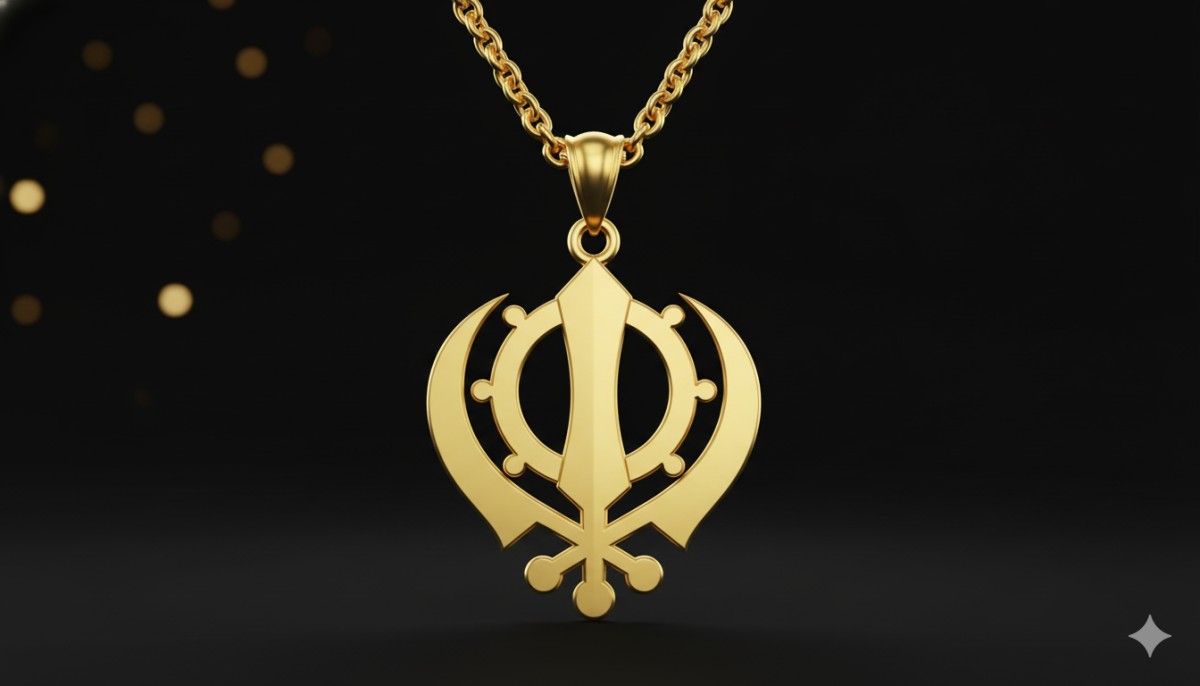
The Khanda Sahib is the definitive emblem of the Sikh faith, encapsulating the entire philosophical foundation of Sikhism in one powerful, striking symbol. More than just a sign, it is a statement of divine justice, courage, sovereignty, and the equality of all humanity. Wearing a Khanda Sahib Gold Pendant is a profound and visible declaration of Sikhi (the Sikh way of life) and serves as a continuous source of spiritual inspiration and protection.
The choice of gold—an eternal, pure metal—elevates this sacred symbol, making the pendant a cherished, daily amulet for Sikh men and women across the globe. This comprehensive guide explores the deep, layered meaning of the Khanda’s components, the trending gold designs for 2025, and the essential etiquette for wearing this most revered symbol with dignity and respect.
Read more: Ruby and Gold Necklace Designs
1. The Sacred Components: Decoding the Khanda Sahib ☬
The Khanda Sahib is a compound symbol, and understanding the meaning of each element is crucial to appreciating the spiritual power of the pendant.
A. The Central Khanda (Double-Edged Sword)
The central double-edged sword gives the symbol its name. This straight-edged sword is the Khanda, representing Shakti (Divine Power) and the division of truth from falsehood. It is the sword of righteousness, upholding justice and freedom.
B. The Chakra (The Steel Circle)
The disc encircling the swords is the Chakra, a perfect circle with no beginning and no end. It symbolizes the perfection of God, eternity, and the unity of all existence. It also represents the defense of righteousness.
C. The Two Kirpans (Crossed Swords)
The two outer curved swords are Kirpans, symbolizing the doctrine of Miri-Piri:
- Miri: The temporal authority (political power).
- Piri: The spiritual authority (religious power). Their placement signifies the Sikh belief that spiritual and political life should not be separated, and the Khalsa must maintain both moral and physical strength.
2. Gold: The Eternal Medium for Enduring Faith
Gold is the metal of choice for the Khanda Sahib pendant due to its inherent qualities that align with Sikh values.
A. Purity and Honor
Gold is non-corrosive and pure, symbolizing the uncorrupted nature of the Sikh faith and the purity of intent required of a Khalsa (baptized Sikh). Its value reflects the honor given to the sacred symbol.
B. Structural Integrity (14K/18K)
For a symbol with sharp, structural elements (the swords), the gold must be hard and durable. 14K or 18K gold is highly recommended over soft 22K gold. The hardness of the 14K/18K alloy ensures that the fine points and the sharp edges of the swords do not bend, dull, or break off during daily wear.
3. Top Trending Khanda Sahib Gold Pendant Designs
Modern designs ensure the pendant is structurally robust while catering to varying aesthetic preferences, from bold statements to subtle faith markers.
1. The Minimalist Outline Khanda
- Design: The most popular modern style features the Khanda crafted entirely in a single, continuous line of thin, high-polished gold. The internal components (the two Kirpans) are rendered as simple cutouts or thin line work.
- Aesthetic: Sleek, lightweight, subtle, and perfectly suited for daily office wear.
2. Statement Black Enamel Inlay
- Design: A bold, high-contrast look where the Khanda’s shape is cut into a gold disc, and the internal area is filled with black enamel (Meenakari).
- Look: Modern, striking, and gender-neutral. The black background makes the gold outline “pop,” emphasizing the structure of the swords and the Chakra.
3. Diamond/Pavé Accented Khanda
- Design: A luxury option where the outline of the Chakra and the central Khanda are paved with tiny, brilliant diamonds or high-quality AD (CZ) stones.
- Aesthetic: High-end and shimmering, perfect for marking religious milestones or major gifting occasions.
4. Engravable Disc Khanda
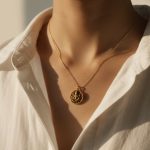
- Design: A simple gold disc pendant with the Khanda Sahib symbol subtly embossed or carved onto the surface. The reverse side is left flat for personalized engraving (e.g., a religious phrase, date, or initials).
- Value: Highly personalized, transforming the pendant into a private, sacred amulet.
5. Layered Khanda: Matte and Polished Fusion
- Design: The pendant uses a dual-texture finish: the outer Chakra might have a matte (brushed) finish, while the inner swords (Khanda and Kirpans) are given a high-polish finish.
- Look: Adds depth and dimension, distinguishing the components and appealing equally to men and women seeking a textured look.
4. Styling and Design for Gender and Age
The Khanda Sahib is gender-neutral, but the styling often differs to suit men’s and women’s jewelry trends.
A. Styles for Men
Men typically prefer larger, heavier pendants (often 5 to 10 grams) worn on thicker, longer gold chains (22 to 24 inches). Matte finish, brushed gold, and black enamel inlay designs are favored for their masculine, structural look.
B. Styles for Women
Women often choose smaller, lighter pendants (2 to 5 grams) worn on thinner chains (16 to 18 inches). High-polish, diamond-accented, or minimalist outline designs are preferred for a delicate, stackable look.
C. Structural Integrity Check
Regardless of size, always ensure the fine points of the Khanda and Kirpans are securely soldered. The bail (the loop connecting the pendant to the chain) must be robust, ideally a sturdy oblong or split-ring design to hold the weight securely during daily wear.
5. Wearing Etiquette and Spiritual Conduct
Wearing the Khanda Sahib pendant requires reverence and adherence to certain principles to honor its sacred nature.
A. Placement and Cleanliness
The Khanda Sahib pendant should always be worn above the clothing line and above the waist. The wearer should ensure the pendant is kept clean; regular cleaning with mild soap and water is necessary to maintain the purity of the gold.
B. Conduct While Wearing
It is paramount that the wearer maintain respectful conduct while wearing the symbol. The pendant should be removed during any unsanitary activities (like bathing, sleeping, or entering washrooms, although personal interpretation varies) to uphold the honor of the sacred emblem.
C. Chain Choice
Choose a chain that is appropriate for the pendant’s size and weight. A strong rope chain or box chain is ideal for heavier pieces, ensuring the pendant sits securely close to the heart.
Conclusion
The Khanda Sahib Gold Pendant is the ultimate expression of the Sikh faith, courage, and commitment to justice. By choosing a durable, beautifully crafted design in 14K or 18K gold, Sikh men and women carry a constant, visible source of spiritual strength and a profound declaration of their identity and adherence to the Khalsa principles of truth and righteousness.
Frequently Asked Questions (FAQs)
Which gold purity is recommended for the Khanda Sahib pendant?
14K or 18K gold is highly recommended. The added hardness from the alloy makes the fine edges of the swords more durable and resistant to bending or breaking than softer 22K gold, ensuring the symbol’s structural integrity.
Should the Khanda pendant be worn over or under the clothing?
It can be worn both ways. Wearing it over clothing makes a public statement of faith. Wearing it underneath, close to the skin, is an intimate, personal symbol of protection and devotion.
Is the Khanda Sahib worn by women as well as men?
Yes, absolutely. The Khanda Sahib is a gender-neutral symbol of the Sikh faith. Women typically wear smaller, more delicate versions, often accented with diamonds or a high polish.
What is the most appropriate way to clean the pendant?
Clean the pendant with mild soap and lukewarm water only. Use a soft cloth or a very soft toothbrush to gently clean around the intricate joints and inside the Chakra. Avoid harsh chemicals, which can strip the gold or damage enamel inlays.
Is it necessary to wear the Khanda pendant on a gold chain?
While gold is traditionally preferred for its purity, the pendant can be worn on a sturdy silver, platinum, or even a robust dark leather/fabric cord. The symbolism of the Khanda is far more important than the material of the chains.