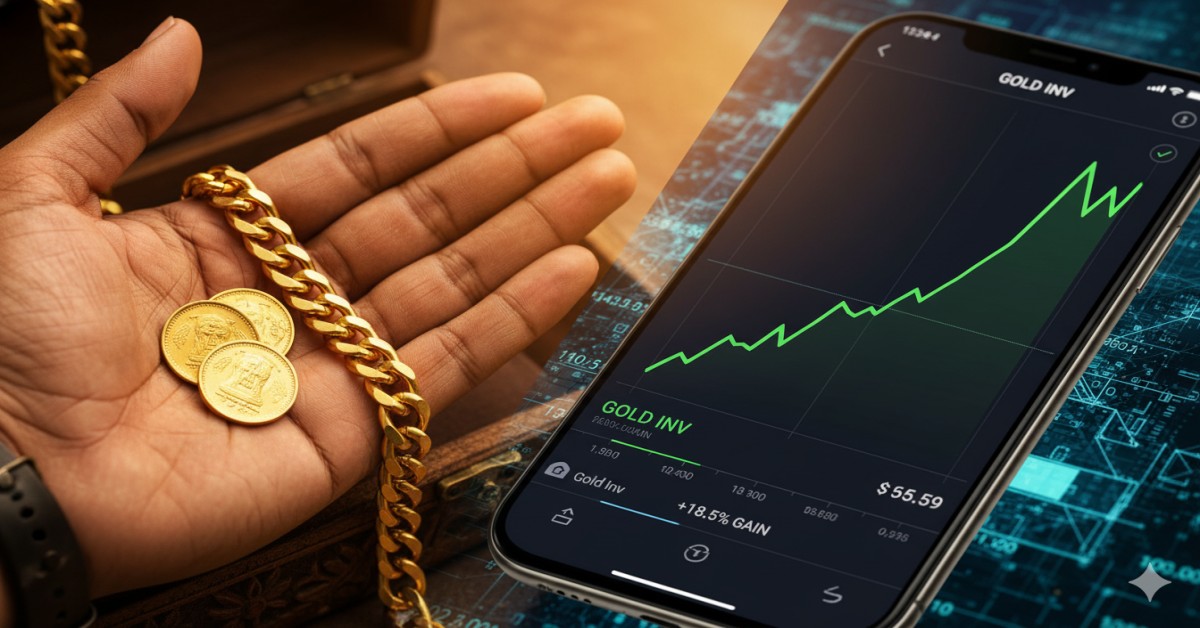
If you were to open your grandmother’s jewelry box and then open your stock trading app, you would be looking at two very different versions of the same asset. One is heavy, shiny, and holds memories of weddings and festivals. The other is a number on a screen that flashes green or red.
For centuries, Indians have equated “investing” with “buying jewelry.” But in late 2025, with gold prices crossing historic highs (₹1.2 Lakh per 10 grams), the conversation has shifted. Financial influencers are screaming about Sovereign Gold Bonds (SGBs) and ETFs, calling physical gold “dead money” because of making charges.
But is it really dead money? Or does Physical Gold offer a kind of power that digital numbers simply cannot replicate?
In this guide, we are going to settle the debate of Investing in High Purity Jewellery vs. Digital Options. We will move beyond the basic “returns” argument and look at the real-world value of tangibility, crisis utility, and the emotional ROI that no spreadsheet can calculate.
Read more: The Ultimate Bridal Gold
The Case for Physical Gold: “Wealth You Can Wear”
Let’s address the elephant in the room: Making Charges.
Yes, when you buy jewelry, you lose 10-20% of your money instantly to labor costs. Mathematically, it seems like a bad deal.
But physical gold serves a purpose that digital gold never can: Dual Utility.
1. The “Zero-Day” Liquidity
Imagine a worst-case scenario. The internet is down. Banking servers are hacked. A natural disaster strikes.
Can you trade your Gold ETF for food or passage? No.
But a 22k Gold Chain? That is universal currency.
Physical gold is the ultimate crisis hedge. It requires no electricity, no internet, and no KYC verification to function as money in an emergency. This “sovereign independence” is the true power of physical gold.
2. The Emotional ROI

You cannot wear a Gold Bond to your cousin’s wedding.
Jewelry provides “Dividends of Joy.” Every time you wear a set, you get value from it. If you wear a bangle for 20 years and then sell it, even if the financial return is slightly lower than an SGB, the usage value you got over two decades makes up for it.
3. Smart Buying: How to Beat the “Making Charge” Trap
You can make physical gold a powerful investment if you stop buying “Fashion Gold” and start buying “Investment Gold.”
- Stick to 22k Plain Gold: Avoid stones. Avoid enamel. Buy solid gold bangles and chains.
- Low Making Charges: Look for machine-made designs where making charges are capped at 8-12%.
- The “Bullion Jewellery” Trend: In 2025, we are seeing a rise in “Coin Jewelry”—necklaces made of 24k or 22k coins. These have minimal wastage and fetch near-bullion rates upon resale.
The Case for Digital Options: “Pure Profit”
If your goal is strictly to grow your wealth with zero emotional attachment, Digital Gold wins on paper. Let’s look at the three main players in 2025.
1. Sovereign Gold Bonds (SGBs)
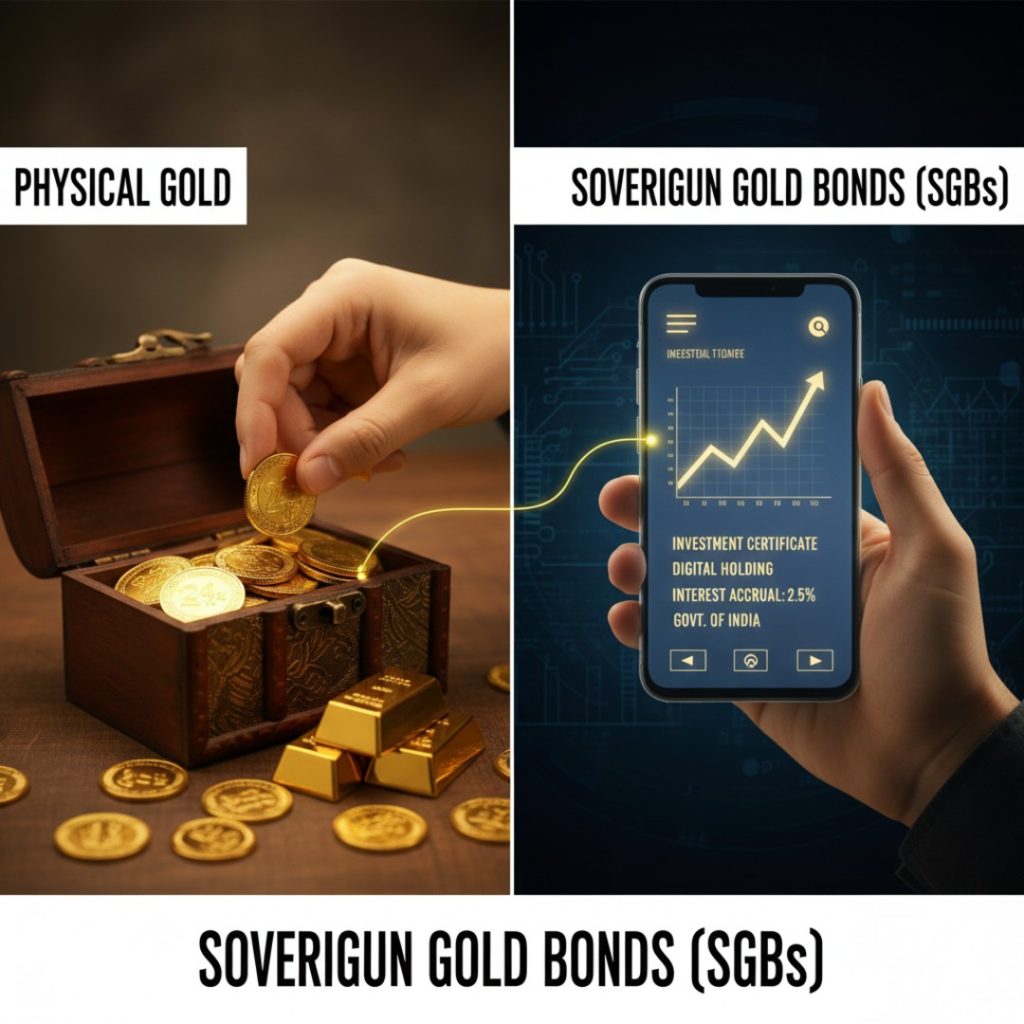
This is the government’s darling.
- The Pro: You earn 2.5% interest every year on top of the gold price appreciation.
- The Tax Magic: If you hold until maturity (8 years), the capital gains are 100% Tax-Free. No other gold asset offers this.
- The Con: It has a lock-in period. You cannot sell it instantly in an emergency (unless you trade it on the stock exchange, where liquidity can be low).
2. Gold ETFs (Exchange Traded Funds)
- The Pro: Highly liquid. You can buy and sell during market hours instantly. The buying cost is very close to the actual gold rate (very low spread).
- The Tax (2025 Update): As per the latest tax rules, gains on Gold ETFs held for more than 12 months are taxed at 12.5% (without indexation). Short-term gains are taxed as per your income slab.
- The Con: You need a Demat account, and there is a small annual expense ratio (0.5% – 1%).
3. Digital Gold Apps (PhonePe, GPay, Jar, etc.)
- The Pro: You can buy gold for as low as ₹10. It’s great for micro-savings.
- The Hidden Trap: The Spread. The difference between the Buying Price and Selling Price on these apps is often 3% to 6%. You start with a loss the moment you buy. Plus, you have to pay 3% GST even on digital gold.
- Verdict: Avoid this for large investments. Use it only for loose change savings.
Head-to-Head: Physical vs. Digital (2025 Edition)
| Feature | High Purity Jewellery (Physical) | Sovereign Gold Bond (SGB) | Gold ETF |
| Purity | 22k (91.6%) | 999 (Paper backed) | 999 (Paper backed) |
| Making Charges | 10% – 20% (Loss) | Zero | Zero |
| GST | 3% on value + 5% on labor | Zero | Zero (Baked into price) |
| Storage Cost | Locker Rent / Theft Risk | Zero | Demat Charges (Minimal) |
| Liquidity | High (Sell at any shop) | Medium (Exchange traded) | Very High (Instant) |
| Returns | Gold Price Appreciation | Gold Price + 2.5% Interest | Gold Price Appreciation |
| Taxation | LTCG 12.5% (>24 months) | Tax-Free (at maturity) | LTCG 12.5% (>12 months) |
| Utility | Wearable / Crisis Hedge | None | None |
The “Hybrid” Strategy: The Winner’s Approach
So, should you dump your jewelry and buy bonds? No.
The smartest investors in 2025 are using a 50-30-20 Hybrid Strategy.
1. The “Core” Portfolio (50% in SGBs/ETFs)
Use SGBs for your long-term wealth—funds you are saving for your retirement or a child’s education 10 years down the line. The tax-free benefit is too good to ignore.
2. The “consumption” Portfolio (30% in Physical Jewellery)
This is your “Stree Dhan.” Buy high-purity, low-wastage 22k gold jewelry that you can wear.
- Tip: Don’t look at this purely as an investment. Look at it as a “Lifestyle Asset” that retains value. Even if you lose 15% on making charges, the joy of wearing it for 10 years is worth that cost.
3. The “Liquidity” Portfolio (20% in Gold Coins/Bars)
Keep some physical Gold Coins (24k) or Bars at home or in a locker.
- Why: These have very low making charges (2-4%) compared to jewelry. In a sudden emergency where you need cash tonight (and markets are closed), these coins are your lifeline.
Tax Implications: The 2025 Shift
It is crucial to understand the new tax landscape.
- Physical Gold: If you sell jewelry after holding it for 24 months, you pay a flat 12.5% Long Term Capital Gains (LTCG) tax. (The old benefit of indexation is gone).
- Gold ETFs: The holding period for LTCG has been reduced to 12 months. Gains after 1 year are taxed at 12.5%.
- SGBs: Still the king of taxes. No tax on redemption after 8 years.
This shift makes Gold ETFs slightly more attractive for medium-term investors (1-3 years), while Physical Gold remains a long-term hold game.
Conclusion: Tangibility is a Feature, Not a Bug
In an increasingly digital world, there is a primal comfort in holding a solid gold bangle.
Digital gold gives you Numbers.
Physical gold gives you Power.
Don’t let the “making charge” argument scare you away from jewelry entirely. Just be smarter about it. Stop buying 18k studded fashion jewelry as an “investment.” Start buying 22k solid gold.
Balance your portfolio. Let the SGBs build your wealth in the background, but keep the physical gold close for the days you need to shine—or survive.
I’d love to know: Do you trust digital gold, or do you need to hold the metal in your hand to feel secure? Let me know in the comments below!
Frequently Asked Questions (FAQs)
Is digital gold safe from theft?
When you buy Digital Gold (from apps) or Gold ETFs, the physical gold is stored in insured vaults by custodians (like MMTC-PAMP). You face no risk of theft at home. However, Digital Gold apps carry “Platform Risk”—if the app shuts down, you might face hassles. ETFs are safer as they are regulated by SEBI.
Which has better resale value: 24k Coins or 22k Jewellery?
24k Coins have better resale value. Since they are 99.9% pure and have negligible making charges, you get nearly the full market rate of gold when you sell. Jewellery will always have a deduction for making charges and potential impurities (soldering).
Can I convert my Digital Gold into Physical Jewellery?
Yes, most apps (like Tanishq Digital Gold, Jar, etc.) allow you to redeem your digital balance against physical jewelry.
The Catch: You will have to pay the Making Charges and GST at the time of conversion. So, you aren’t saving money on making charges; you are just delaying the payment.
Why is SGB considered better than physical gold for pure investment?
Two reasons: Interest and Tax. SGB pays you 2.5% interest every year (which physical gold does not). And if you hold SGB for 8 years, your profit is tax-free. Physical gold profits are taxed at 12.5%. Mathematically, SGB yields roughly 30-40% higher returns over 8 years compared to physical gold.
Does physical gold protect against inflation better than digital gold?
Both protect against inflation equally well because the underlying asset is the same: Gold. However, Physical Gold offers better protection against hyper-inflation or currency collapse scenarios where banking systems might fail, as it is a tangible asset you possess directly.